Treks & Climbs in Wadi Rum Jordan
Price
£17.00

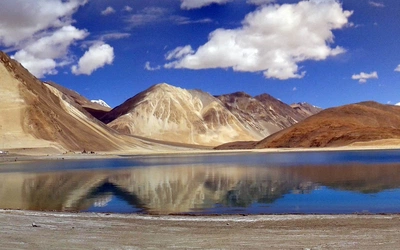
The scenic grandeur of Wadi Rum received its first accolade from Lawrence of Arabia in his Seven Pillars of Wisdom. His description of his entry into the Wadi is memorable:
“Day was still young as we rode between two great pikes of sandstone to the foot of a long, soft slope poured down from the domed hills in front of us. It was tamarisk-covered: the beginning of the Valley of Rumm, they said. We looked up to the left to a long wall of rock, sheering in like a thousand-foot wave towards the middle of the valley; whose other arc, to the right, was an opposing line of steep, red broken hills. We rode up the slope, crashing our way through the brittle undergrowth.
“As we went, the brushwood grouped itself into thickets whose massed leaves took on a stronger tint of green the purer for their contrasted setting in plots of open sand of a cheerful delicate pink. The ascent became gentle, till the valley was a confined tilted plain. The hills on the right grew taller and sharper, a fair counterpart of the other side which straightened itself to one massive rampart of redness. They drew together until only two miles divided them: and then, towering gradually till their parallel parapets must have been a thousand feet above us, ran forward in an avenue for miles.
“They were not unbroken walls of rock, but were built sectionally, in crags like gigantic buildings, along the two sides of their street. Deep alleys, fifty feet across, divided the crags, whose plans were smoothed by the weather into huge apses and bays, and enriched with surface fretting and fracture, like design. Caverns high up on the precipice were round like windows: others near the foot gaped like doors. Dark stains ran down the shadowed front for hundreds of feet, like accidents of use. The cliffs were striated vertically, in their granular rock; whose main order stood on two hundred feet of broken stone deeper in colour and harder in texture. This plinth did not, like the sandstone, hang in folds like cloth; but chipped itself into loose courses of scree, horizontal as the footing of a wall.
“The crags were capped in nests of domes, less hotly red than the body of the hill; rather grey and shallow. they gave the finishing semblance of Byzantine architecture to this irresistible place: this processional way greater than imagination. The Arab armies would have been lost in the length and breadth of it, and within the walls a squadron of aeroplanes could have wheeled in formation. Our little caravan grew self-conscious, and fell dead quiet, afraid and ashamed to flaunt its smallness in the presence of the stupendous hills.
“Landscapes, in childhood’s dream, were so vast and silent. We looked backward through our memory for the prototype up which all men had walked between such walls toward such an open square as that in front where this road seemed to end. Later, when we were often riding inland, my mind used to turn me from the direct road, to clear my senses by a night in Rumm and by the ride down its dawn-lit valley towards the shining plains, or up its valley in the sunset towards that glowing square which my timid anticipation never let me reach. I would say, ‘Shall I ride on this time, beyond the Khazail, and know it all? But in truth I liked Rumm too much.”
Wadi Rum is a totally new area for rock-climbing and mountaineering and was first visited with these sports in mind as recently as October 1984 by a party of four English climbers (including myself), at the invitation of the Jordanian Ministry of Tourism. Apart from one climb made prior to this date only the Bedouin were familiar with the area and its mountains, including the top of Jebel Rum, which at 1,754m was Jordan’s highest peak prior to changes in the Saudi/Jordan border to give increased coastal facilities to Aqaba. There is now a higher summit close to the new border in the south east of the Rum area, called Jebel um Adaami, 1,830m, which gives a nice scramble with amazing views.
Most of the peaks in the region have in fact been climbed by the Bedouin, often by more than one route, during hunting expeditions or whilst collecting edible or medicinal plants and herbs. Although originally climbed and reversed solo in barefeet and without any equipment, some of these routes are quite serious undertakings with complex route finding. The Bedouin are proud of them and rightly so! There are however a number of possibly unclimbed peaks in the area, as well as many new routes to be done on the various walls, ridges, slabs and crack systems, not to mention easier routes and scrambles through canyons with magnificent scenery.
Despite what at first may look to be horrendously soft and loose rock it will soon be found that excellent climbing is to be had here and that the quality of the rock adds a peculiar spice to the climbs rather than detracting from them. It is a remote and spectacular landscape, offering unlimited rock for the pioneer, as well as many superb existing routes of all grades of difficulty, whilst the desert and numerous “siqs” or canyons offer a wilderness experience not to be found elsewhere in the world. The wealth of this experience is further increased by the Bedouin whose homeland this is, and by the variety of wildlife to be found in the area. It is hoped that this book will allow others to savour the solitude and mystical magic of these deserts and mountains.