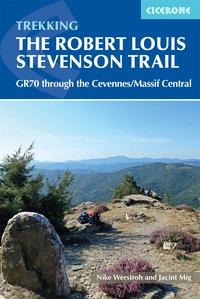
Walking in the Cevennes
Price
£12.00

Walk 18 - Sentiers des Menhirs
Difficulty: Moderate – an uphill climb to get to the ridge
Time: 4hrs + time to explore the village
Height gain: 355m
Maps: Cartes IGN 2739 OT Top 25 Mont Lozère 1:25,000
Start point: Village of Les Bondons (15km from Florac)
Signposting: No signs but green splashes and arrows all the way round. One blue splash at the inter section of La Pierre Plantée
A magnificent walk with extended views in all directions – you feel as though you are walking round the top of the world. The fantastic number of standing stones (menhirs) is an added attraction.
Why our Neolithic ancestors erected these stones over 4000 years ago is an unsolved mystery, though many theories have been put forward. In the Bondons area alone over 150 stones have been discovered, many of them lying on the ground. A programme of study and restoration has been set up in the area and most of the stones have now been re-erected and cemented in place so that they do not fall again. It is worthwhile wandering round the little village of Bondons – it has incredibly old houses with a very distinctive architecture, many of them unfortunately in a bad state of repair.
How to get there (from Florac)
Go north out of Florac, direction Mende, over the Tarn at the Pont de la Bessède, and then left on the N106. After a few hundred metres turn right on the D998, direction Bédouès/Pont-de-Montvert, and continue through the village of Bédouès before turning left, direction Bondons (4.5km from the turn-off) on the D135. Drive up this narrow winding road for 8km until you see a sign left to Bondons. Drive over a bridge and park in the first open space on the left at the bottom of the village, where you will notice a green splash on a concrete telephone pole.
Directions
(1) Go back the way you came across the bridge over a stream to meet the wider road.
(2) Turn right and after a few metres look for a narrow road up left, signposted ‘Lozerette’ with a green arrow (5mins). This road circles round the south side of a conical hill called Mont Vert. The D135 goes through another attractive valley on the right, and there is a low ridge ahead with pine trees. On the right are the vestiges of an old uranium mine, which looks like a grassy amphitheatre, and later there are some large rocks through the trees on either side. When the road turns a corner you can see several tall stones, or menhirs, silhouetted against the sky on a higher ridge, which you will walk along later.
(3) At a fork (25mins) continue right. The road goes down over a stream on a humpbacked bridge into the hamlet of Lozerette. This is a tiny hamlet, which is mostly in ruins, though there are signs of habitation and vegetable gardens – some of the houses are being renovated.
(4) Take a grassy path up left where there is a green splash on a rock. The path is initially bushy and crosses a stream before traversing fairly steeply up the side of the hill. There is a clear view of Lozerette and, further on, Le Crouset in the valley below. If you look back you can see Mont Vert framed by the two rounded humps of the Mamelons de Puech and the village of Les Bondons; unfortunately the view is partially spoiled by large, ugly cattle sheds, which have been built higher up. You can also see and hear waterfalls. The path continues upward through a fence by the intersection at the top of the ridge called La Pierre Planté (55mins).
(5) Turn left here (there is a blue splash this time) and ignore a further blue splash on a stone, right, which is the way down the other side of the ridge to Ruas. Continue straight along the ridge following green splashes. The path goes up gently, passing another hump to the right, Le Truc (alt. 1175m), and round an impressive wide gully whose steep, bare slopes descend to trees and deep green fields. There is a path running through the gully from Lozerette. Continue along the ridge through another fence; further on, if you look back, you can see an impressive menhir on the ridge behind. The path reaches two stone menhirs standing together and a smaller one not far off (see introductory paragraph above). There are also piles of stones and remains of primitive shelters at this spot.
Continue onwards, where there is a fence to the left. Beyond, left, is another high ridge that you will be walking along later, with a solitary high menhir etched on the skyline. Ahead is a road and the village of La Veissière to the right. The path continues past more menhirs and further on you can see others dotted around – there are about 12 in all and it is a quite extraordinary sight.
(6) At a fork keep left (1hr 45mins) and descend gently through three fences to join a jeep track. You can now see Les Colobrières in a valley down on the left. The track goes upwards, passing a big, ugly quarry on the left, to reach the D35 road (2hrs).
(7) At the road turn left, going down and then up past a restored cottage to the left.
(8) After 20 minutes look for a path to the left, clearly marked with a green arrow. This is a defined jeep track with fences each side, crossing barren flat ground called Le Cham des Bondons. To the right and left are other huge stones. In springtime there are fields of white narcissi and yellow and blue orchids.
(9) Watch for a green arrow, which takes you off left and over a smart stile (2hrs 30mins). The path is not clear, but continue towards another stile ahead and then later on a third one. After going over a slight rise, the high menhir you saw from the earlier ridge comes into view, standing alone and commanding a dramatic view of hills and valleys stretching into the distance. The tall cliffs of the Causse Méjean are on the right skyline and nearer is another flat ridge separated by a gully, with the two unmistakable humps of the Mammelon de Puech beyond.
(10) Careful – from the menhir the ridge starts to slope gently downwards and the path is not evident. Follow the piles of stone and cairns, some of which have green splashes on them. On the right is a deep gully, called Combe de la Sourde on the IGN map. As the ridge drops down to the left it becomes a wide shoulder, and you can see a narrow road in the valley below. Bearing slightly right, cross a fence by a stile and green splashes just after a solitary hawthorn tree, and continue down the undefined path with the occasional cairn to guide you (look back and you can see there is a line of cairns down the shoulder). From here, you can also see exactly where you went along the ridge on the other side.
(11) Cross a jeep track, which seems to disappear into the grass at the end of the shoulder, and keep going down, bearing left until you come to another fence. Keep the fence on your right and follow green splashes until you come to a kissing gate (3hrs 15mins). After the gate, the path bears right and goes down the hill into the end of the Combe de la Sourde valley, which looks very lush. A ‘combe’ is a shallow valley and ‘sourde’ means deaf, but the author could not find out how it got such a name! Beyond is the Mont Vert hill dotted with small firs, which cast speckled shadows on the slope in the sunlight.
(12) At the bottom of the valley, go through another fence and over a dry streambed before heading gently up the other side. At a rather undefined fork in an open area go up right following a green arrow on a flat stone. The gravely track turns round the north side of the Mont Vert and you can see the village of Les Bondons ahead. As you zigzag down again there is a large house called St Martin set in a small wooded valley and you can clearly see the road beyond. The path is sunken and bushy as it goes deeper into the lush valley, becoming very narrow, rocky and slippery at the bottom. It eventually crosses a little stream and a few minutes later meets the road by an ancient stone cross (3hrs 45mins).
(13) Cross over diagonally left onto a narrow lane (green splashes here) and a few minutes later you rejoin the road into the village. As you turn a corner there is a very old house, which is being renovated (with a possible date of 15– over the door). Bear down left by the war memorial to the parking area at the bottom of the village (4hrs).