Walking in Scotland's Far North - A Walker's Guide
Walking in Scotland's Far North
by Andy Walmsley
The 62 mountain walks in this guidebook cover Scotland's north-west peninsula, north of Ullapool. Mainly day walks, taking in peaks such as Suilven, Quinag, Morven and Scaraben, with three longer mountain traverses (Assynt Horseshoe, a Raey traverse and a long ascent of Cranstackie). More...
Buy from Cicerone
Seasons
Year-round walking, as the area is warmed by the Gulf Stream, and snow rarely lingers for long. Read More... Driest months are May, June, September and October. Warnest in July and August, but full of midges!Centres
Ullapool, Lochinver, Kylesku, Scourie, Kinlochbervie. Otherwise various small scattered villages Read More... offering accommodation and basic amenities.Difficulty
Routes are not graded, but are all within the reach of a reasonably fit walker.Must See
It’s all beautiful! Provided the weather allows you to see it. Tiny welcoming villages. Remote Read More... mountain scenery, rugged coastline and perfect sandy beaches.The ‘far north’ is one of Scotland’s best-kept secrets. Despite its many attractions, the area is largely ignored by British holidaymakers, though it is popular with visitors from elsewhere in Europe. Even at the height of the summer season, the area is never really busy, and this is one of its attractions to the connoisseur who appreciates the solitude, the rugged coastline and the unique landscape with its bumpy gneiss moorland and jutting peaks.
The country’s northern peninsula, with the remote headland of Cape Wrath at its tip, is covered in this guide as far as Ullapool in the south and Dunbeath in the east. The guide is selective rather than comprehensive, however, and readers will notice a bias towards the west side of the northern peninsula. This is intentional, as most of the rugged (and thus the most interesting) terrain is concentrated there; but Morven (the highest summit in the old county of Caithness) and its neighbour Scaraben, are included, along with a couple of other interesting routes on the eastern side. The far north-eastern corner of Caithness (the ‘lowlands beyond the highlands’), including John o’Groats, Wick and Thurso, is not covered.
The area has some of the most challenging and spectacular mountains in the British Isles, including splendid peaks such as Suilven and Quinag, yet because they are mostly below Munro status most of the hills have been spared the worst excesses of exploitation. Nevertheless, the far north hills stand head and shoulders above many a Munro in terms of interest and character.
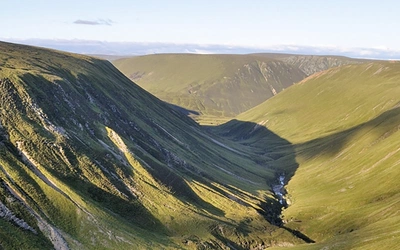
A large part of the area covered by the guide is made up of lumpy gneiss moorland, sprinkled with a multitude of tiny lochans, which form an unusual landscape. Readers who like wild, remote country with extensive vistas opening up around each corner will find many routes to their liking. There is a real feeling of spaciousness up here, which is often lacking further south.
Another jewel of the far north is the coastline. From Ullapool north to Cape Wrath, and then east as far as Strathy Point, the Atlantic seaboard threads a ragged line, encompassing wonderful little crofting settlements, spectacular headlands, excellent beaches, fjord-like sea lochs, fascinating offshore islands (including the Summer Isles and Handa Island), the British mainland’s highest sea cliffs and two of Scotland’s most celebrated sea-stacks – the Old Man of Stoer and Am Buachaille.
As if this were not enough, the area has limestone caves, Britain’s highest waterfall and a number of interesting antiquities! Surely such variety in so small an area is unique.
Surprisingly, although this is the farthest-flung corner of the British mainland, the mountains are all relatively accessible, being fairly close to roads in most cases. However, they are also quite well scattered, and for this reason it is difficult to climb a large number of them from one fixed base. The dedicated peak-bagger would have to move around by car quite a bit to collect them all, using a number of different bases. With this in mind, I have mentioned the best bases for each area at the end of the area introduction.
Topography
Much of the southern area of the guide, Coigach and Assynt, consists of the characteristically choppy moor, composed of ancient gneiss rocks and made up of innumerable abrupt little hillocks cradling a multitude of tiny lochans. This terrain seldom rises much above 200m, leaving peaks such as Suilven standing in spectacular isolation. Many of the peaks consist of huge outcrops of Torridon sandstone, a rock which weathers into fantastic pinnacles and spires and which has a superb rough texture, ideal for scrambling.
Further north, above Rhiconich, there is more schist, giving a smoother more boggy type of moor, and rising from this are the majestic quartzite peaks of Arkle and Foinaven, characterised by their swooping ridges and dazzling screes.
Moving eastwards from the coast the mountains generally become less shapely and thus less interesting, but hills such as Ben Leoid, Ben Hee and the Munro Ben Klibreck give good walking in superb lonely terrain.
Even further east, the mountainous terrain of the west gives way to a bleak rolling moorland with very few interesting summits. The exception to this is the area immediately inland of Berriedale on the east coast, where outcroppings of sandstone have produced the distinctive peaks of Morven, Smean, Maiden Pap and Scaraben – well worth a visit.
Overlooking the north coast village of Tongue are the prominent isolated peaks of Ben Loyal (often given the sobriquet of ‘Queen of Scottish Mountains’) and Ben Hope (most northerly of the Munros). Ben Loyal is a shapely peak, but lacks the pinnacled ridges of Suilven or Stack Pollaidh, while Ben Hope is of simple form but is challengingly craggy, particularly its northern ridge, which provides the most difficult ascent route.
The coastline, especially in the west and north, is almost as spectacular as the mountains and boasts a number of features which are worth a visit. North from Ullapool, the coast skirts around Loch Kanaird and Ardmair Bay, then passes beneath the cliffs of Ben Mor Coigagh, with the Summer Isles offshore at this point, before reaching the exposed headland of Rubha Coigeach. Turning abruptly south-west, the coast passes the extensive sands of Achnahaird Bay, and twists and turns around the innumerable inlets of Enard Bay (including Loch Inver) before encompassing a string of sandy beaches on the run out to the Point of Stoer, with its spectacular sea stack the Old Man of Stoer.
From here the shoreline penetrates deep inland, to the heads of the fjord-like lochs Glencoul and Glendhu, then threads a ragged line north, encompassing the island-studded Eddrachillis Bay. After sneaking past the Isle of Handa, the coast forms two more fjord-like sea lochs in Lochs Laxford and Inchard, before reaching the beach at Sandwood Bay.
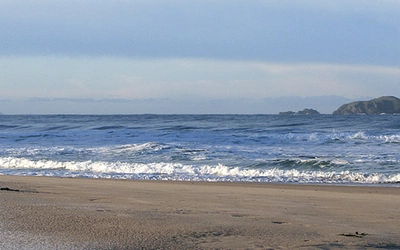
Sandwood Bay would be a crowded and commercialised place if it were situated further south, or even if accessible by road, but it has escaped the attentions of the day-tripping crowds because of its remoteness. Its 2km of reddish sand, overlooked by the sea stack known as Am Buachaille, is completely unspoilt and often deserted.
North of the bay the coast becomes rugged again as it rises to the headland of Cape Wrath, with its stubby lighthouse. This is Britain’s most remote headland (but not the most northerly). Turning east, the coast presents a series of high cliffs to the crashing seas of the Atlantic, the ones at Cleit Dubh being the highest on the British mainland, but these gradually subside into the gentle shores of the shallow Kyle of Durness with its mud flats and sand dunes.
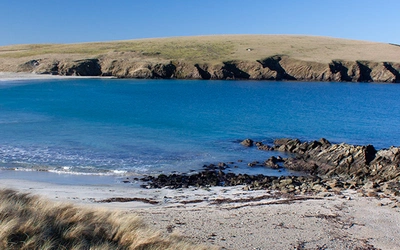
Beyond the sandy headland of Fair Aird (variously referred to as Faraid Head or ‘Far Out Head’) a series of delectable coves with sandy beaches lead along to the mouth of Loch Eriboll, by far the largest of the ‘fjords’ along this coast. Eriboll is often used as a deep-water refuge by shipping during stormy weather.
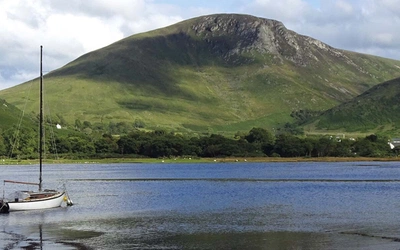
The Kyle of Tongue, which is the next inlet along the coast, is completely different from the brooding Eriboll, being a shallow firth like the Kyle of Durness, but it is overlooked by the majestic Ben Loyal, giving it a scenic quality which is lacking in its neighbouring sea lochs.
Continuing east, the coast shortly reaches Bettyhill at the outlet of Strath Naver, which is the border of this area of the guide.