

 Reprinted
Walking La Via de la Plata and Camino Sanabres
The Camino de Santiago from Seville to Santiago de Compostela and Astorga


Walking La Via de la Plata and Camino Sanabres
The Camino de Santiago from Seville to Santiago de Compostela and Astorga
Guidebook to walking La Vía de la Plata and Camino Sanabrés, a pilgrim route through Spain. A 995km route between Seville and Santiago de Compostela or Astorga (where it links with the Camino Francés). Ourense variants are also provided.Walk the full 995km (619 miles) La Vía de la Plata and Camino Sanabrés with this comprehensive stage-by-stage guidebook, covering the route from Seville to Santiago de Compostela or Astorga. As the longest of the main Camino de Santiago routes, this historic pilgrimage crosses Andalucía, Extremadura, Castilla y León and Galicia, offering a quieter, more contemplative alternative to the Camino Francés for reasonably fit long-distance walkers.
Expertly written by experienced walker Nicole Bukaty and published by Cicerone, this practical and inspirational guidebook divides the entire route into 43 manageable stages of 11–35km (7–22 miles). Detailed route descriptions are supported by clear 1:100,000 mapping, larger-scale town plans and downloadable GPX files, providing everything needed for confident self-guided walking on this Spanish Camino.
- 43 stage-by-stage route descriptions covering the full La Vía de la Plata from Seville northwards, with guidance on walking the route in sections from key transport hubs including Salamanca, Zamora and Ourense
- Two finish options: complete the route at Astorga or continue on the Camino Sanabrés to Santiago de Compostela, with alternative variants via Laza and Verín to Ourense
- 1:100,000 mapping and detailed urban maps to support navigation on rural tracks, through open plains and into historic cities such as Mérida and Seville
- Downloadable GPX files for use on smartphones and GPS devices, giving another option for navigation along the pilgrim trail
- Comprehensive accommodation listings, including detailed albergue information and advice on advance booking to help plan your itinerary
- Planning guidance and pilgrim advice, including practical preparation tips and information on obtaining pilgrim credentials
With complete stage-by-stage route descriptions, mapping, GPX files and accommodation guidance in one volume, this guidebook gives you everything required to plan and walk the La Vía de la Plata and Camino Sanabrés. Choose your start point, shape your stages and set out with confidence on Spain’s longest and most rewarding Camino pilgrimage.
La Vía de la Plata & Camino Sanabrés – Quick Facts
Trail name: La Vía de la Plata & Camino Sanabrés
Location: Western Spain (Andalucía, Extremadura, Castilla y León, Galicia)
Total distance: 995km / 619 miles
Typical duration: 6–8 weeks (full route)
Start: Seville
Finish: Astorga or Santiago de Compostela
Trail type: Waymarked Camino de Santiago pilgrimage route
Difficulty: Moderate to challenging (long-distance endurance required)
Terrain: Roman roads, rural tracks, open plains, dehesa pastureland, historic towns and rolling Galician hills
Navigation: Waymarked with Camino arrows and markers; guidebook mapping and GPX recommended
Best season: Spring (April–June) and autumn (September–October)
Accommodation: Albergues (pilgrim hostels), guesthouses, hotels and rural accommodation
Author Highlight
“Crossing four very distinct autonomous regions of Spain, this Camino winds through beautiful, solitary landscapes dotted with pretty little towns. Approximately once a week, it lands in a grandiose city with treasures that take you back in time and where all pilgrim comforts are to be found. Yet take care, as this is not an easy Camino and should not be underestimated.”
- Nicole Bukaty, author of Walking La Via de la Plata and Camino Sanabrés
Printed book
A guidebook with detailed route descriptions, stage breakdowns, accommodation listings, profiles and maps - everything you need on the trail.
ISBN
9781786310804
Availability
Published
Published
27 Sept 2023
Edition
First
Pages
320
Size
17.20 x 11.60 x 1.80cm
Weight
370g
eBook
The complete digital edition of the guidebook, with full route descriptions, accommodation listings, profiles and maps, ready to use on any device. To access your eBook, you will need an eReader app. For more details, visit the eBook FAQs.
CONTENTS
Route summary tables
Map key
Overview map
Map of the Spanish Caminos
Overview profile
Foreword
General introduction
A brief history of the Camino de Santiago
The Vía de la Plata and the Camino Sanabrés
Landscape, economy, cultures and languages
Planning your Camino: before and during
The pilgrim experience
Route and schedule options
Getting there and back
When to go
Planning your day to day on the Camino
Accommodation
Food
Budget planning
Preparation and training
What to pack
Baggage and storage services
Local facilities and practical information
Waymarking, shells and symbols
Safety and health
How to use this guide
GPX download
SECTION 1: SEVILLA TO MÉRIDA
Stage 1 Sevilla to Guillena
Stage 2 Guillena to Castilblanco de los Arroyos
Stage 3 Castilblanco de los Arroyos to Almadén de la Plata
Stage 4 Almadén de la Plata to El Real de la Jara
Stage 5 El Real de la Jara to Monesterio
Stage 6 Monesterio to Calzadilla de los Barros
Stage 7 Calzadilla de los Barros to Zafra
Stage 8 Zafra to Villafranca de los Barros
Stage 9 Villafranca de los Barros to Torremejía
Stage 10 Torremejía to Mérida
SECTION 2: MÉRIDA TO GRANJA DE MORERUELA
Stage 11 Mérida to Aljucén
Stage 12 Aljucén to Alcuéscar
Stage 13 Alcuéscar to Valdesalor
Stage 14 Valdesalor to Casar de Cáceres
Stage 15 Casar de Cáceres to Cañaveral
Stage 16 Cañaveral to Galisteo
Stage 17 Galisteo to Carcaboso
Stage 18 Carcaboso to Hotels Asturias and Jarilla
Stage 19 Hotels Asturias and Jarilla to Puerto de Béjar (Colonia la Estación)
Stage 20 Puerto de Béjar (Colonia la Estación) to Fuenterroble de Salvatierra
Stage 21 Fuenterroble de Salvatierra to San Pedro de Rozados
Stage 22 San Pedro de Rozados to Salamanca
Stage 23 Salamanca to Calzada de Valdunciel
Stage 24 Calzada de Valdunciel to El Cubo de Tierra del Vino
Stage 25 El Cubo de Tierra del Vino to Zamora
Stage 26 Zamora to Montamarta
Stage 27 Montamarta to Granja de Moreruela
SECTION 3: EXTENSION TO ASTORGA
Extension Granja de Moreruela to Astorga and the Camino Francés
SECTION 4: CAMINO SANABRÉS TO OURENSE
Stage 28 Granja de Moreruela to Tábara
Stage 29 Tábara to Santa Marta de Tera
Stage 30 Santa Marta de Tera to Rionegro del Puente
Stage 31 Rionegro del Puente to Asturianos
Stage 32 Asturianos to Requejo
Stage 33 Requejo to Lubián
Stage 34 Lubián to A Gudiña
A Gudiña to Ourense via Laza
Stage 35 A Gudiña to Laza
Stage 36 Laza to Alberguería
Stage 37 Alberguería to Xunqueira de Ambía
Stage 38 Xunqueira de Ambía to Ourense
A Gudiña to Ourense: variant via Verín
Stage 35A A Gudiña to Verín
Stage 36A Verín to Xinzo de Limia
Stage 37A Xinzo de Limia to Allariz
Stage 38A Allariz to Pereiras (connection with Stage 38 to Ourense)
SECTION 5: OURENSE TO SANTIAGO DE COMPOSTELA
Stage 39 Ourense to Oseira
Stage 40 Oseira to Botos (Estación de Lalín)
Stage 41 Botos (Estación de Lalín) to Dornelas
Stage 42 Dornelas to Deseiro (Sergude)
Stage 43 Deseiro (Sergude) to Santiago de Compostela
Appendix A Stage planning tables
Appendix B Spanish–English glossary of key terms
Appendix C Useful contacts and links
Appendix D Bibliography
Seasons
Walkable at any time of the year but ideally in Spring and Autumn, especially when leaving from Sevilla. Winters are mild in the south but can be harsh after Mérida.
Centres
Sevilla, Zafra, Mérida, Cáceres, Salamanca, Zamora, Benavente, La Bañeza, Astorga, Puebla de Sanabria, Ourense and Santiago de Compostela.
Difficulty
Suitable for all walkers. Prior Camino experience is helpful to walk at the very least 20km self-sufficiently in difficult weather conditions at any given time. Stages are graded from Easy to Very hard.
Must See
Five UNESCO World Heritage cities plus Zafra, Zamora, Astorga and Ourense. Innumerable national heritage sites and Roman ruins. Vast, empty landscapes: meadows, hills, farms, rivers, forests. Travel through four autonomous regions: Andalucía, Extremadura, Castilla y León and Galicia.
June 2024
Accommodation updates
Code
[A] | Albergue (pilgrim hostel) |
[Ho] | Hotel |
[Ca] | Camere (rooms) |
[Cm] | Camping |
[BB] | Bed & Breakfast |
[Ag] | Agriturismo |
[O] | open year round |
[Pr[ | private rooms available |
[Dr] | communal dinner available |
[Do] | dormitory room available |
[R] | advanced reservations accepted |
[K] | kitchen available |
[Br] | breakfast included |
[Cr] | credit cards |
[W] | washing machine |
[S] | bicycle storage |
[Z] | disability access |
- Stage 1: in Guillena, end of stage - additional accommodation
[A] Albergue Municipal de Guillena [O][Do][R][K][Br][W][S] 3/14, €14, Av. de la Vega s/n, tel 955 785 262 or 667 727 380 or 665 068 222, pedroguillena@hotmail.com. Pilgrims are accommodated in this albergue only if the Albergue Luz del Camino is full as both are run by the same hosts.
- Stage 2: in Castilblanco de los Arroyos, end of stage - price increase and address clarification
[A] Albergue La Posada de Escardiel [O][Do][R][K][Br][W][S] 2/7, €17, cl. Pilar Nuevo 15, tel 641 024 128, email laposadadeescardiel@gmail.com. Sells the credencial €2, price includes breakfast.
- Stage 3: in Almadén de la Plata, end of stage - price increase
[A] Albergue La Casa del Reloj [Do][K][W][S] 2/10, €13, Plaza del Reloj 9, tel 692 552 659, luisevaristoml@gmail.com. Open all year except Christmas.
- Stage 4: in El Real de la Jara, end of stage - reminder of new albergue municipal
[A] Albergue Municipal La Casa del Cura [O][Do][R][K][W][S][Z] 2/10, €10, cl. Real, 39, tel 633 248 505, email alberguerealjara@gmail.com. Price €15 on presentation of the credencial
- Stage 6: in Calzadilla de los Barros, end of stage - price increase
[A] Albergue de peregrinos de Calzadilla de los Barros [O][Do][W][S][Z] 2/10, €10, Polígono Encarnación 3, tel 924 584 745. Keys from town hall before 15:00, otherwise phone numbers are on the door.
- Stage 7: in Zafra, end of stage - opening time clarification, credencial information and price increase
[A] Albergue de peregrinos de Zafra (Vincent Van Gogh) [O][Do][R][S] 6/36, €12, Av. de la Estación 17, tel 924 969 123 or 617 846 551. Sell the credencial.
[A] Albergue Convento San Francisco [Do][R][Br][W][S] 6/21, €12/-/30/-, Av. Fuente del Maestre 2, tel 680 663 806 or 924 036 245. Open all year except Christmas, sometimes take breaks at varied points of the year.
- Stage 8: in Los Santos de Maimona, along the stage - price decrease
[A] Albergue Vía de la Plata de Los Santos de Maimona [O][Do][S] 2/12, €7, Cl. Maestrazgo s/n, tel 924 54 48 01 or 924 54 42 94, oficinadeturismo@lossantosdemaimona.org. Keys from tourist office or police station.
- Stage 8: in La Almazara, along the stage - reminder that the Albergue Turístico La Almazara is closed permanently
- Stage 8: in Villafranca de los Barros, end of stage - price increase
[A] Albergue Extrenatura [Do][Pr][R][Br][K][W][S] 2/10 & 4/8, €15/25/45/-/-, Cl. Carvajales 2, tel 924 986 181 or 669 964 546. Call ahead and look for updates due to unpredictable closures at variable times of the year.
- Stage 9: in Torremejía, end of stage - price increase
[A] Albergue Rojo Plata [O][Do][R][K][S] 4/22, €16, Cl. José de Espronceda 23, tel 658 854 372, reservas@albergue-rojo-plata.com, http://albergue-rojo-plata.com
- Stage 13, in Aldea del Cano, along the stage - the Albergue municipal Miliario del Verdinal has closed indefinitely
- Stage 15, in Cañaveral, end of stage - price increase and capacity clarification
[A] Hostel Cañaveral [O][Pr][Do][R][Br][Cr][W][S][Z] 4/24 &1/3, €16/-/43/53, Av. Doctor Luis Boticario 12, tel 669 402 446 or 655 351 976, info@hostelcanaveral.com, www.hostelcañaveral.com
- Stage 16, in Galisteo, end of stage - the Albergue Turístico de Galisteo is closing from 31 May 2024 for an indefinite period of time
- Stage 17, in Carcabodo, end of stage - price increase
[H] Hostal Ciudad de Cáparra [O][Pr][R][S] 5/10, €-/30/60, Ctra. de Plasencia 35, tel 927 402 032 or 927 402 444. Check prices directly.
- Stage 18, in Oliva de Plasencia, alternative off route lodging - price increase
[A] Albergue Turístico San Blas [O][Pr][Do][R][K][S] 4/16, €21/35/50/-/-, Cl. Real 2, tel 647 563 450, pichon24@hotmail.com.
- Stage 19, in Aldeanueva del Camino, along the stage - new albergue municipal
[A] Albergue de peregrinos de Aldeanueva del Camino [O][Do][W][S][Z] 2/10, €Donation, Cl. las Olivas 52. Keys from the bar Hogar del Pensionista on Cl. Gabriel y Galán 77.
- Stage 19, in Baños de Montemayor, along the stage - price increase
[A] Albergue Turístico Vía de la Plata [O][Do][R][Br][W][S] 3/12, €15, Cl. Castañar 40, tel 655 620 515, sagrariocastelani@yahoo.es. Breakfast €3.
- Stage 22, in Morille, along the stage - price increase
[A] Albergue de peregrinos de Morille [O][Do][S] 1/24, €10, Cl. Mayor s/n, tel 659 928 010. Keys from Bar Marcos.
- Stage 23, in Calzada de Valdunciel, end of stage - price increase
[A] Albergue de peregrinos de Calzada de Valdunciel [O][Do][K][S] 1/8, €8, Cl. La Cilla 21, tel 717 706 637. Keys from the ACUM behind the albergue (Mon–Fri 11:30–13:00) or the library on Cl. Teresa Herrero behind the church (Mon–Fri 18:00–20:00), otherwise call them.
- Stage 24, in El Cubo de Tierra del Vino, end of stage - price increase and cost clarification
[A] Torre de Sabre [Pr][Dr][Do][R][Br][W][S] 3/10, €18/29/40/54/72, Tr. de la Ermita 1, tel 633 424 321, torredesabre@gmail.com. The dorm price of €32 includes a three-course dinner with drinks and plentiful breakfast with vegetarian options available. Open year-round but check ahead Nov–Jan.
- Extension to Astorga, in Barcial del Barco - price increase
[A] Albergue Las Eras [O][Do][R][K][Br][W][S][Z] 1/14, €12, Cl. las Eras 2, tel 980 640 073 or 675 550 051, barborox@hotmail.com. Register at Bar Borox.
- Extension to Astorga, in Benavente - price increase, telephone numbers and key collection
[A] Albergue de peregrinos de Benavente [Do][K][S] 2/12, €5, Ctra. de la Estación, tel 980 634 211 or 643 800 803, turismo@benavente.es. In the old railway station. Open 1 Mar–31 Oct. Keys from the albergue (Mon–Fri 12:30–22:00), the tourist office on Plaza Mayor (Sat–Sun 10:00–14:00) and the police station on Cl. Villalpando (Sat–Sun afternoons, tel 980 63 13 49).
- Extension to Astorga, in Astorga - price increase
[A] Albergue Só Por Hoje [Pr][Dr][Do][R][Br][W][S] 1/10 & 2/4, €29/-/69/-/-, Cl. Rodríguez de Cela 30, tel 690 749 853, info@alberguesoporhoje.com, https://alberguesoporhoje.com. Open Mar–Nov. Breakfast included.
- Stage 28, in Tábara, end of stage - price increase
[A] Albergue/Restaurante El Roble [Pr][Do][R][Br][Cr][W][S][Z] 1/14 & 15/28, €12/30/74/66, Cl. el Prado 3, tel 650 629 969 or 980 590 300, elrobletabara@gmail.com, www.turismoruralelroble.es. Closed 24 and 25 Dec.
- Stage 29, in Villanueva de las Peras, along the stage - price increase, availability and access changes
[A] Albergue Alameda [Pr][Do][R][K][Cr][W][S] 1/12 & 3/7, €10/20/30/45, Cl. Alameda 21, tel 696 321 223 or 980 641 799, villanuevabar@yahoo.es. Open 1 March to 31 October inclusive.
- Stage 30, in Olleros de Terra, along the stage - the Albergue/Restaurante La Trucha is reported closed indefinitely, but alternative accommodation has opened
[H] Casa Julia [O][Pr][K][Br][W][S] 5/10, €-/25/50/-/-/-/-, Cl. las Eras 15, tel 660 088 620 or 630 787 997. Washing machine included. Cooked food and groceries available to purchase in the shared kitchen.
- Stage 33, in Lubián, end of stage - price clarification
[A] Albergue de peregrinos de Lubián [O][Do][K][S] 2/16, €3, Cl. de la Cruz s/n, tel 980 624 003. €5 with heating.
- Stages 34, 35, 36, 37, 38, 35A, 36A, 37A, 38A, 39, 40, 41, 42 and 43 - reminder that all albergues municipales in Galicia have a cost of €10 per bed in dorms.
- Stage 35, in Campobecerros, along the stage - the Albergue da Rosario is reported closed indefinitely, but alternative accommodation is available
[H] Pensión Casa Núñez [Pr][Br][Dr][S] 4/8, €-/35+/-/-/-/-, Rúa Campobecerros 2, tel 988 077 624 or 608 887 835.
- Stage 38, in Ourense, end of stage - price increases
[A] Grelo Hostel [O][Do][R][Br][W][S] 3/32, €16, Rúa Peña Trevinca 40 bajo, tel 988 614 564, info@grelohostel.com, www.grelohostel.com. Breakfast included.
[A] Albergue Augas Quentes [O][Do][R][Br][W][S] 3/36, €18, Rúa Vicente Risco 34, tel 988 061 322 or 679 958 780, info@albergueaugasquentes.com, www.albergueaugasquentes.com. Breakfast included.
- Stage 37A, in Allariz, end of stage - new albergue option
[A] Albergue Allariz [Pr][Do][R][K][Br][Dr][W][S][Z] 3/22, €13-15/25//42/60/80, Estrada de Xunqueira 7, tel 604 024 328, email info@albergueallariz.com, https://albergueallariz.com/. Availability varies, reservations required at least two days in advance, group discounts.
- Stages 39 and 40, in Castro Dozón, either at end of variant stage or along the stage - new accommodation option
[A] Casa Bubela [Pr][Do][R][K][Br][Dr][W][S] 3/9, €-/35+/-/-/-/-, Rúa Doutor Martínez Iglesias s/n, tel 620 542 503. Open 1 March to 31 October inclusive.
- Stage 41, in Silleda, along the stage - clarification of albergue options and price increases
[A] Albergue Santa Olaia [O][Do][R][K][W][S] 18/70, €10, Av. del Parque 17, tel 679 508 709 or 619 521 475, alberguesantaolaia.info@gmail.com, www.alberguesantaolaia.es
[A] Albergue Turístico Silleda [O][Pr]Do][R][K][W][S] 11/28, €12/23/33/33/-, Cl. Venezuela 38, tel 643 898 693, reservas@albergueturisticosilleda.es, www.albergueturisticosilleda.es
[A] Albergue Trabazo [O][Do][R][W][S] 3/24, €15, Cl. Alfonso Trabazo 8–2o, tel 722 129 401, alberguetrabazo@gmail.com, www.alberguetrabazo.com.
[A] El Gran Albergue Silleda [O][Do][R][K][Dr][W][S] 9/20, €10, Rúa Antón Alonso Ríos 18, tel 611 286 757 or 986 580 156 , elgranalberguedesilleda@gmail.com.
- Stage 42, in Deseiro (Sergude), end of stage - price increase
[A] Albergue Reina Lupa [Pr][Do][R][W] 1/14 & 2/4, €18/-/50/-, Deseiro N-525, tel 981 511 803 or 679 842 829, info@alberguereinalupa.com, http://alberguereinalupa.com. Closed 15 Dec–15 Jan.
April 2024
Clarification of the Vía Verde option on Stage 19 p132
The Vía Verde option (recommended) route should read: 'Go through the car park of Hotel Asturias, which is located directly across the N-630 from the hotel itself. At the far end of the car park take a path past two buildings and turn left onto the Vía Verde (disused railway track), which promptly goes under a road. Go under another road (3.8km) and pass the old Casas del Monte railway station. At a junction by a ruin (3.6km), etc...'
February 2024
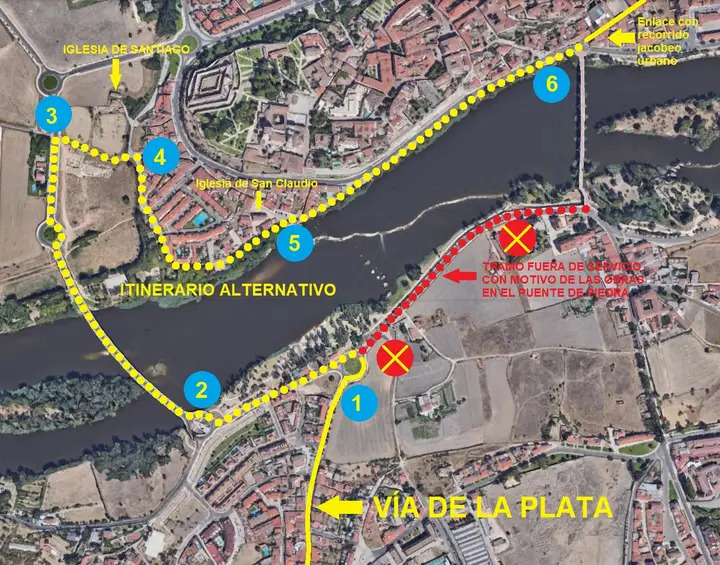
From February 2024: Temporary diversion and alternative route before entering Zamora (Stage 25)
The local associations for pilgrims have added new arrows and covered existing waymarkers for pilgrims to enter Zamora due to ongoing works along the usual path. Pilgrims should now follow the new arrows and ignore the old ones for the next few months. Updates will be provided.
Please see the images where the current route is marked in yellow and in purple for ease.
p.166-167 of the guidebook temporarily read as follows:
“Turn left towards a roundabout (bar) but keep to the road on the right, passing the Iglesia de San Frontis. Turn left at the next roundabout onto Ctra. Carrascal, pass a playpark on the right. Reach another roundabout and go right to cross over the Río Duero river on the bridge known as the Puente de los Poetas (bridge of the poets).
Keep ahead across the roundabout with views of the old town of Zamora to the right, turn right along a narrower lane and right at the next junction. Keep right passing a park and reaching the riverside.
Continue all the way to the Puente de Piedra stone bridge to follow signs for the albergue and tourist office. Pass by the Museo Provincial de Bellas Artes then the Iglesia de Santa María, behind which turn left. Keep left uphill then turn right up Cuesta San Cipriano to the albergue.”
February 2024
Stage 1 Route change between Santiponce and Guillena as of February 2024
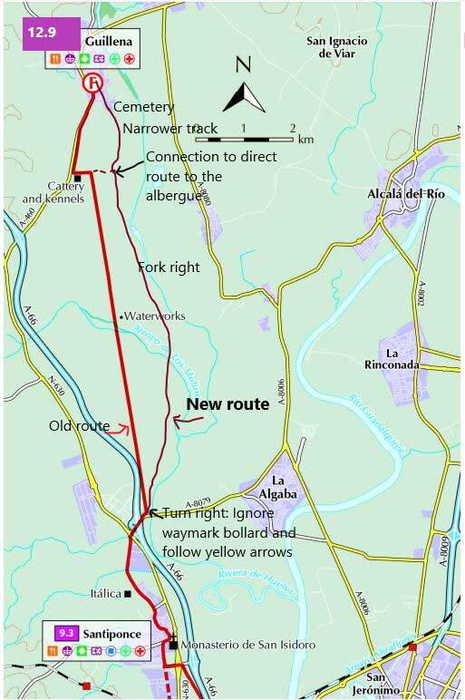
Due to persistent flooding in winter along the dirt tracks between Santiponce and Guillena on Stage 1, the pilgrim Association of Sevilla has painted new yellow arrows to mark a new and recommended route that avoids flooding by making use of bridges across the stream called Arroyo de los Molinos and other streams. The waymarking bollard has not yet been moved but should now be disregarded by pilgrims, and the yellow arrows followed instead.
The new updated GPX files for this stage are now also available to download.
Note: this very same stream can often be dried up at other times of the year.
Please consider these 5 important points therefore:
- Changes affect pp52-53 route descriptions after the Roman ruins of Itálica. The new description reads as follows:
Keep to the same road towards the highway, cross over the roundabout and go under the A-66 (1.7km). Turn left on a wide dirt track and left again onto another wide track. Almost immediately ignore the waymarking bollard (old route) that keeps straight and instead fork right onto a track following yellow arrows.
Keep straight along the same track ignoring any tracks from the left and right and passing buildings before taking the bridge over the Arroyo de los Molinos (3.6km). Having passed a ruined building, at the next fork (2.3km) take the righthand track. Use a ford/bridge, then another and a third to then head left onto a wider dirt track and reach a bend with a narrower track on the right (2.0km) and two options to arrive in Guillena.
Direct route to the albergue (unwaymarked then waymarked): Keeping to the wider track by turning left leads to a cattery and kennels (0.7km) where yellow arrows from the old route are still present. Take the next track on the right, alongside the road. The path steps down onto the road into Guillena and reaches the albergue on the left.
New waymarked route: Use the narrower track by forking right and again keep straight after the next fork on narrower route over the Arroyo Galapagar (0.8km). Keep straight as the track turns into a road in Guillena to pass the cemetery (0.6km) and at the fork, now in town, keep left to take cl. Sevilla on the left. After 400m reach cl. Garcia Lorca with the albergue on the other side of the road slightly to the left.
- Changes affect p47 and the Stage Information box
Start Sevilla Cathedral
Finish Guillena
Distance 22.2km
Total ascent 171m
Total descent 164m
Difficulty Easy
Duration 5½hr
Percentage paved 37%
Albergues Santiponce 9.3km; Guillena 22.2km
- The distance from Santiponce to Guillena is now 12.9km.
The municipality box on p.53 which now reads: 12.9km GUILLENA
- Page 1 Route summary table
Please now instead consider the Stage Information given above for Stage number 1.
- Appendix A on p300
Note that the distance from the previous place for Guillena is now 12.9km, the itineraries on this stage are now 400m longer. Finally, the overall distance of the Vía de la Plata to Santiago de Compostela is 400m longer!
February 2024
Albergue de Peregrinos de Fontanillas de Castro (Stage 27)
We bid farewell to beautiful Diva, the Afghan hound, who passed away this week and who helped host pilgrims. Angela and Paco miss her very much but are, as ever, looking after pilgrims in the most caring way.
February 2024
Accommodation update
Availability dates at the albergue municipal in Castilblanco de los Arroyos
As of February 2024, the albergue municipal in Castilblanco de los Arroyos (Stage 2) has changed its opening/closing schedule.
p56 - Stage 2 in Castilblanco de los Arroyos (at stage end)
Albergue de peregrinos de Castilblanco de los Arroyos [Dorm rooms] [Kitchen] [Storage for bikes] 2/30, €Donation, Av. Antonio Machado s/n, tel 955 734 811, email oficinaturismocastilblanco@gmail.com. Closed 1 December to 31 January and 1July to 31 August.
February 2024
New albergue municipal in El Real de la Jara
As of January 2024, a new albergue municipal in El Real de la Jara has opened and can be considered for accommodation.
p65 - Stage 4, in El Real de la Jara (at stage end)
Albergue Municipal La Casa del Cura [Open all year] [Dorm rooms][Reservations possible] [Kitchen] [Washing and drying machine] [Storage for bikes] [Wheelchair access] 4/18, €15-18, cl. Real, 39, tel 633 248 505, email alberguerealjara@gmail.com, cost of stay €15 on presentation of the credencial
p64 – last paragraph should now read:
'other accommodation options, including a brand new albergue municipal, host pilgrims in the town centre'
January 2024
Accommodation update
Accommodation closure from January 2024:
Very sadly, as of January 2024, the La Almazara albergue on Stage 8 has had to close due to a lack of funds from the Extremadura council.
This affects the following pages:
p46: in the Planning section, please disregard point 3.
p78: in the green route overview box, I would still suggest the recommended route passing by the building of the La Almazara albergue as it is pleasant and a safer crossing over the N-630.
P79-81: on the map and in the route description, please do not consider La Almazara as an option for drinking water, food or lodging. It has closed entirely. Therefore, the distance from Los Santos de Maimona to Villafranca de los Barros is 16.4km with nowhere to stock up in between.
Note: as stated in the book, the albergue in Villafranca de los Barros closes at short notice at unpredictable times of the year. You may wish to secure accommodation at the hotel Hostal Rural Casa Perín indicated on p.81 of the guidebook.
September 2023
Luggage storage
Ivar Revke, who stores luggage for pilgrims in Santiago de Compostela, has changed his address to
Casa IvarATT:
[Your name goes here]
Rúa Nova 7
15705
Santiago de Compostela
España
Therefore, p.37 in the guidebook should now read:
'Casa IvarATT: [Your name goes here] Rúa Nova 7 15705 Santiago de Compostela España'
Note: for full details of services, it is worthwhile reading his webpage:
September 2023
Stage 2 albergue and price increases
As of September 2023, a new albergue has opened and can be considered for accommodation:
p.56 - Stage 2, in Castilblanco de los Arroyos (at stage end)
[Private albergue] Albergue La Posada de Escardiel [Open all year] [Dorm rooms] [Reservations possible] [Kitchen] [Breakfast] [Washing and drying machine] [Storage for bikes] 2/7, €15, cl. Pilar Nuevo, 15s/n, tel 641 024 128, email laposadadeescardiel@gmail.com, sells the credencial €2, price includes breakfast
Update as of 18 September 2023:
The new set price for albergues municipales in the Galicia region is €10 (it was previously €8).
P.31 of the guidebook in the Accommodation section under the sub-heading “Albergues” should read “In Galicia, albergues municipales ... and cost €10 euros”
This now affects the following albergues listed in the guidebook:
p.232 Albergue de peregrinos de A Gudiña
p.237 Albergue de peregrinos de Laza
p.242 Albergue de peregrinos de Vilar de Barrio
p.244 Albergue de peregrinos de Xunqueira de Ambía
p.249 Albergue municipal de peregrinos de Ourense Eligio Rivas Quintas
p.255 Albergue de peregrinos de Verín
p.259 Albergue de peregrinos de Viladerrei
p.261 Albergue de peregrinos de Xinzo de Limia
p.263 Albergue de peregrinos de Sandiás
p.276 Albergue de peregrinos de Cea
p.278 Albergue de peregrinos del Monasterio de Oseira
p.284 Albergue de peregrinos de A Laxe (Bendoiro)
p.287 Albergue de peregrinos de Bandeira
p.292 Albergue de peregrinos de Outeiro
Free Royal Mail 48 postage on UK orders. European postage is £3.50 per item. Worldwide postage is £5.50 per item. If you're not happy with your purchase for any reason, we'll give you a full refund.
Learn moreDiscover the Cicerone App
The Cicerone App brings decades of expertise straight to your phone, making it easier than ever to plan and enjoy your adventures wherever you are. For use with In-App guides — not compatible with eBooks.


Popular related guides


