Walking in the Ochils, Campsie Fells and Lomond Hills

 
33 contrasting walks in central Scotland’s Ochils, Campsie Fells and Lomond Hills. Despite their proximity to Edinburgh, Glasgow and Perth, these three ranges remain a remarkably uncrowded wilderness area. Offer a mixture of moorland peaks, steep-sided glens, fast-flowing burns and lush woodland in a single day’s outing.
 

Walking in the Ochils, Campsie Fells and Lomond Hills

33 Walks in Scotland’s central fells
Author
Cover
Paperback - Laminated
Edition
First
Expand
ISBN_13
9781852844578
Availability
Reprinted

Price

£10.00

Basket
Search inside this Book
Book search powered by Google
 
Seasons
Year round. May, June and September are recommended. Tops of the Ochils are particularly hard and cold in winter.
Centres
Menstrie, Alva, Tillicoultry, Dollar, Glen Devon, Strathblane, Lennoxtown, Milton of Campsie, Kilsyth, Fintry, Kinross, Glenrothes
Difficulty
Circular hillwalking routes of varied difficulty from just under 4km to 25.5km. Basic navigation required.
Must See
Ben Cleuch, Meikle Bin, West Lomond, ‘Round of Nine’ route, Corrie of Balglass, Benarty Hill Ridge, Falkland Palace


Area Guide

The Ochils, Campsie Fells and Lomond Hills form a prominent band of high ground across the central belt of Scotland, providing a dramatic backdrop to the nearby cities of Glasgow, Edinburgh and Perth. Overlooked by many walkers on their way to larger hills in the north, these three ranges provide uniquely wild, challenging and beautiful walks literally on the doorstep of many towns and cities. Ironically, it is perhaps their proximity to these major areas of population which means that although they are some of most accessible wild areas in the country, these hills remain a relatively uncrowded oasis for walkers.

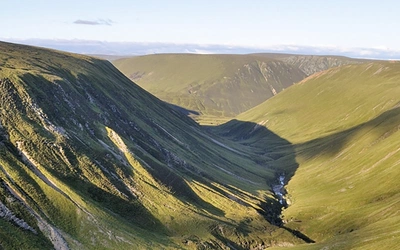
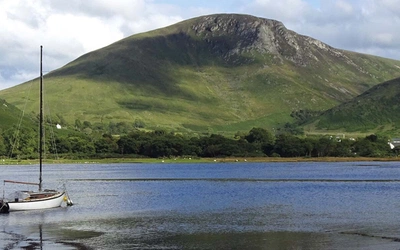
Formed from predominantly igneous rock, each of the ranges shows signs of volcanic creation, perhaps the most obvious indicators being the hills of Dumgoyne, Dumyat and West and East Lomond, whose conical shapes offer distinctive and appealing walks. The other main geological influence is glaciation, which has smoothed away rock to give characteristically broad, plateaued ridges and summits into which burns have gouged steep glens, creating precipitous gorges and waterfalls, in particular on the southern escarpment of the Ochils. The undulating nature of most of the hills is sharply contrasted by some large and spectacular crags and cliffs, most notably the breathtaking Corrie of Balglass in the Campsie Fells, and interesting quartz dolerite intrusions along the west-facing Lomond Hills.

Collectively the three ranges combine a rich mixture of distinct neighbouring habitats, ranging from: montane moorland, ancient and managed forestry, deep lochs and reservoirs, fast-flowing burns and meandering rivers, to rocky crags and fertile carseland. The walker is thus treated to flora and fauna in greater abundance and of greater accessibility than in many of the larger, more remote ranges of Scotland.

This guide offers a mixture of routes, including many popular peaks such as Ben Cleuch, Meikle Bin and West Lomond, as well as areas that are well off the beaten track. The walks have been chosen to reflect the diverse landscape that exists in these ranges, and affords as much importance to smaller peaks and lower-level walks as it does to larger hills and high traverses. Several of the walks include peaks known as ‘Donalds’ – hills in lowland Scotland over 2000ft that have a drop of 100ft on all sides. They are named after Percy Donald, who compiled the original list of these hills.

While some walks are justifiably popular and lined with obvious tracks and paths, walkers are also encouraged to explore routes following the natural lines of ridges and glens where few or no paths exist, so that the guide not only gives details for enjoying some classic routes, but also acts as a starting point for linking and creating endless combinations of different routes. The majority of walks included are circular, and wherever possible start from a suitable place to park a car.

 
Hosting by OUTSRC