


Walking in the Pentland Hills
30 walks in Edinburgh's local hills


Walking in the Pentland Hills
30 walks in Edinburgh's local hills
Guidebook featuring 30 circular walks on Scotland's Pentland Hills, easily accessible from Edinburgh and home to peaks such as Scald Law and Carnethy Hill. Ranging from 2 to 17 miles, the routes are suitable for all abilities. Written by a local Countryside Ranger, the routes offer interesting and varied walking through diverse landscapes.Explore the rich landscapes and hidden heritage of Scotland’s Pentland Hills with 30 inspiring circular walks through Edinburgh’s local uplands. Discover softly rounded summits, quiet waterside paths, rocky valleys, and woodland trails, all within easy reach of the capital.
From gentle strolls to challenging ridge walks, these routes showcase the Pentlands’ diverse geology, fascinating archaeology, literary connections, and stunning views, making them perfect for walkers of all abilities and ideal for year-round exploration.
Ideal for both new and seasoned walkers, this definitive Cicerone guidebook features 30 circular routes ranging from 3 to 27km (2–17 miles), each designed to be completed in 1–8 hours. Enjoy easy access from Edinburgh, Penicuik, West Linton, Lanark, and Biggar, with highlights including the summits of Scald Law and Carnethy Hill, as well as tranquil reservoir-side strolls and remote southern routes for those seeking a wilder experience.
- Experience the best of the Pentland Hills, from undulating ridge walks and deeply incised valleys to quiet lochs, wooded glens, and ancient archaeological remains.
- Enjoy year-round walking in the Pentlands, with routes graded from easy valley strolls and gentle hill rambles to more challenging hikes in the open, exposed southern hills, suitable for every ability and season.
- Choose from 30 varied Pentland walks, each with a 1:50,000 OS map extract, route summary, start and finish points, estimated walking time, detailed information on geology, wildlife, cultural history, and local accommodation options.
- Discover the area’s rich natural and cultural heritage, with routes featuring castles, archaeological sites, place names, dialect words, and literary connections to Allan Ramsay, Sir Walter Scott, and Robert Louis Stevenson.
- Walks range from accessible family-friendly circuits to longer, more remote adventures for experienced hikers, showcasing the full variety of the Pentlands’ landscape and wildlife in every season.
- Explore a walker’s paradise with excellent public transport links and accommodation options in Edinburgh, Penicuik, West Linton, and Lanark, making planning and access simple.
Plan your Pentland Hills adventure with confidence and discover one of Scotland’s most accessible and rewarding walking areas, at your own pace, in every season. With this comprehensive Cicerone guidebook, enjoy summit vistas, tranquil waters, and the rich tapestry of history and wildlife in Edinburgh’s local hills.
Walking in the Pentland Hills – Quick Facts
Location: The Pentland Hills Regional Park, south-west of Edinburgh, Scotland
Number of routes: 30 day walks (all circular)
Distance: 3–27km (2–17 miles) per walk
Duration: 1–8 hours per walk
Areas covered: Edinburgh, Penicuik, West Linton, Lanark, Biggar
Route type: Circular walks, including ridge walks and valley strolls
Difficulty: Suitable for all walkers; from easy family-friendly routes to remote, challenging hikes
Terrain: Grass- and heather-clad hills, ridge and valley paths, reservoirs, rocky glens, woodlands, archaeological sites, castles
Navigation: 1:50,000 OS map extracts included for each walk
Best season: Walks available year-round; mild climate with little snow
Highlights: Scald Law (579m), Carnethy Hill, ridge walks, literary connections, archaeological remains, wildlife, stunning views
Equipment: Walking boots, layered clothing, map recommended
Refreshments & facilities: Information on accommodation in Edinburgh, Penicuik, West Linton, and Lanark; public transport details included for each walk
Author Highlight
"The Pentland Hills comprise a rich tapestry of landscapes and landforms, all neatly packaged within an area easily accessible from Scotland’s majestic capital city. Although principally a grass- and heather-clad, softly rounded hill range, the hills reward further exploration by revealing stunning summit vistas, quiet waterside strolls, deeply incised rocky valleys and wooded walks, as well as a fascinating natural and cultural heritage. The Pentlands are well known to the people of Edinburgh; even for those who have not actually visited them, they form a familiar backdrop to city life.”
- Susan Falconer, author of Walking in the Pentland Hills
Printed book
A guidebook with detailed route descriptions, stage breakdowns, accommodation listings, profiles and maps - everything you need on the trail.
ISBN
9781852848675
Availability
Published
Published
7 Oct 2016
Edition
Second
Pages
176
Size
17.20 x 11.60 x 1.10cm
Weight
200g
eBook
The complete digital edition of the guidebook, with full route descriptions, accommodation listings, profiles and maps, ready to use on any device. To access your eBook, you will need an eReader app. For more details, visit the eBook FAQs.
Introduction
Approaches and Accommodation
Choosing a Walk
Access Rights and Responsibilities
Weather
Equipment
Following a Route
Geology and Landscape
Cultural Heritage
Place Names and Dialect Words
Old Maps
Previous Pentlands Guidebooks
Literary Connections with the Pentland Hills
Protecting and Enjoying the Hills
Wildlife
THE WALKS
Walk 1 A Capital View
Walk 2 In Stevenson's Footsteps
Walk 3 Hill, Moor and Wood
Walk 4 Three Reservoirs
Walk 5 A Phantom Walk
Walk 6 Harlaw Reservoir Circuit
Walk 7 Black Hill, Green Cleuch and Red Moss
Walk 8 Carnethy and Turnhouse
Walk 9 Three Peaks
Walk 10 Pentland Classic
Walk 11 Thieves' Road
Walk 12 West Linton and Siller Holes
Walk 13 Roman Road
Walk 14 Covenanters and Cairns
Walk 15 Walking with Wolves
Walk 16 Poets and Witches
Walk 17 North Esk Valley
Walk 18 The Monks' Road
Walk 19 The Four Tops
Walk 20 The Carnethy 5
Walk 21 Carnethy Canter
Walk 22 History in the Hills
Walk 23 Flotterstone and Fala Knowe
Walk 24 Two Cleuchs
Walk 25 Pentland Tops
Walk 26 Historical Hike
Walk 27 Exploring Caerketton
Walk 28 Find Your Way
Walk 29 Reservoir Round
Walk 30 Robin's Round
Appendix 1: Route Summary Table
Appendix 2: Bibliography
Appendix 3: Glossary
Seasons
All seasons - a mild climate with little snow
Centres
Edinburgh, Penicuik, West Linton, Lanark
Difficulty
A basic level of navigational skills is required, but the routes should not cause any wayfinding difficulties. Height mainly 400-550m.
Must See
Archaeological remains, historical and folkloric associations, castles, literary connections (Scott and RL Stevenson), views from the tops, wildlife
July 2021
2021 reprint route updates
867 reprint 2021 (235.057 KB)
March 2021
Walk 14 Covenanters and cairns
Walk 14
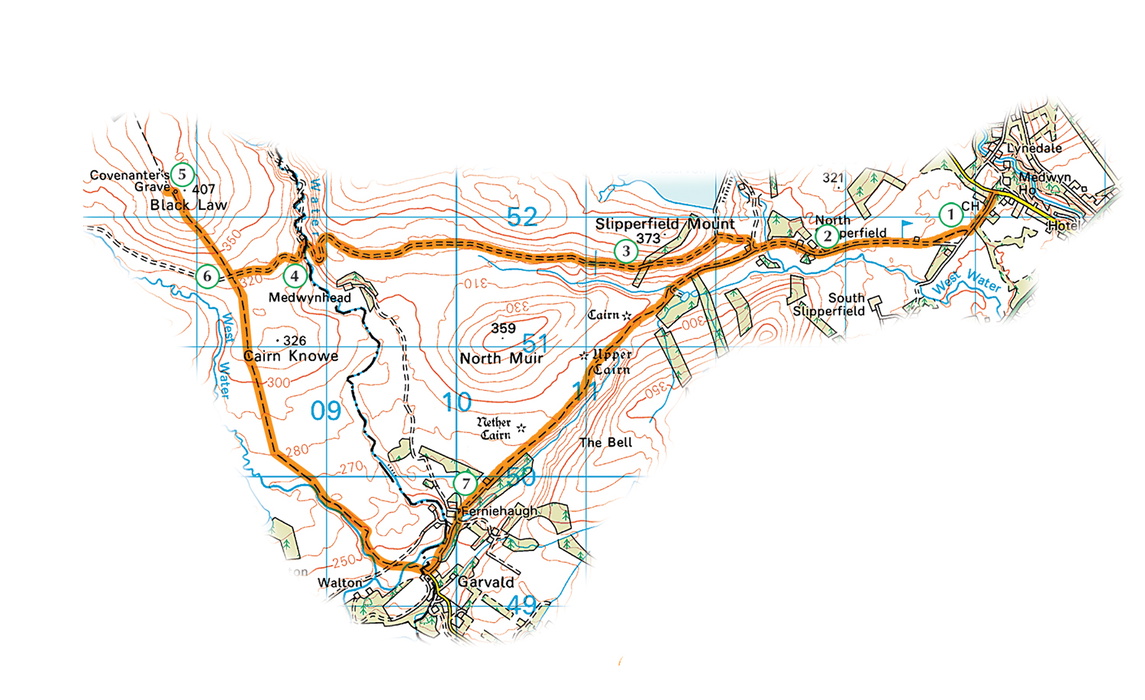
This update refers to all editions and printings. Please note this new route variation avoiding the farm steading at Medwynhead.
Walk 14
Paragraphs 5 and 6
Paragraph 5 should now read:
The Covenanter’s Grave can be tricky to locate. From the main track a wooden crossroads sign at NT082515 indicates Crosswood via the Covenanter’s Grave. Ascend up through the heather and grass towards a line of tall wooden sight posts on the brow of the hill.
IGNORE THIS original wording for paragraph 6 AND USE NEW ROUTE BELOW– Head back along the track, crossing Medwin Water and with the trees surrounding Medwynhead on your right. Go past the end of a plantation and leave the track just beyond a gate. Pick up a faint ATV track and cross boggy ground around the periphery of the fence until you reach a track going due south to the trees atLocket Gate Wood(see OS 344).
Keep on this track as it goes left past another small wood. At the buildings at Medwynhead keep left through the farm steading and come out opposite a lake. From the lake take a track that goes to the left, uphill alongside yet another conifer plantation.
New paragraph 6 route – From the crossroads sign adjacent to the track, follow the indicator directing you south east to Dolphinton via Garvald. There is a line of guideposts across the heather and in places boggy ground. The path becomes faint and can be difficult to locate but chose a line between the posts. The path follows the burn to your right and you’ll eventually reach another signpost. Go through the gate next to the signpost following the sign to Dolphinton and West Linton. After a few metres go right at the next waymarker and cross a wooden footbridge. From here follow the waymarkers to Garvald Home Farm. At the signpost follow the indicator to West Linton 4 miles.
Take the track going between two stone pillars. When the track divides, go straight along between another pair of stone pillars with the name Ferniehaugh.
Walk up the track to a small lake and keep heading uphill to the north of a conifer plantation.
Free Royal Mail 48 postage on UK orders. European postage is £3.50 per item. Worldwide postage is £5.50 per item. If you're not happy with your purchase for any reason, we'll give you a full refund.
Learn moreDiscover the Cicerone App
The Cicerone App brings decades of expertise straight to your phone, making it easier than ever to plan and enjoy your adventures wherever you are. For use with In-App guides — not compatible with eBooks.


Popular related guides


