


Trekking in Mallorca
GR221 - The Drystone Route through the Serra de Tramuntana


Trekking in Mallorca
GR221 - The Drystone Route through the Serra de Tramuntana
Guidebook to walking the GR221 Drystone Route (Ruta de Pedra en Sec) traversing Mallorca's Serra de Tramuntana between Pollença and Andratx. Following rock, paved paths and mule tracks between welcoming villages, the 140km (87 mile) trek is in 10 day stages and showcases the island's forests, mountains and drystone structures.Discover some of the best trekking in Mallorca on the GR221 – Mallorca’s Drystone Route. This spectacular long-distance trail runs 140km (87 miles) through the sun-drenched Serra de Tramuntana mountains, stretching from Port d’Andratx in the south-west to the historic town of Pollença in the north-east. Linking a string of delightful mountain villages via ancient paths and mule tracks, the GR221 offers a unique way to explore the rugged, unspoilt heart of Mallorca, far from the island’s bustling beach resorts.
Best suited to walkers with some experience of long-distance routes, this comprehensive Cicerone guidebook divides the GR221 trail into 10 manageable daily stages, with additional alternative starting points (s’Arracó, es Capdellà, Calvià) and finishing options (Cala Tuent, Alaró, Orient, Caimari, Port de Pollença), allowing flexibility to create your perfect itinerary.
- Traverse the dramatic limestone ridges, shady forests, terraced hillsides, and sun-scorched valleys of the Serra de Tramuntana, a UNESCO World Heritage Site. Pause in charming villages such as Estellencs, Valldemossa, Deià, and Sóller, where life moves at a gentler pace, and welcoming cafés offer well-earned refreshments.
- The main GR221 route runs from Port d’Andratx to Pollença, but variant routes and extensions add further possibilities for exploration, totalling an additional 90km (56 miles) for those wishing to extend their adventure.
- Enjoy year-round walking on Mallorca, with spring and autumn providing the most comfortable conditions for trekking. In spring, almond trees bloom, and the countryside bursts into life, while autumn brings ripe oranges and grapes to the valleys.
- Details optional detours to climb neighbouring peaks, including the iconic Puig de Maria, for panoramic views across the island and the Mediterranean Sea.
- Provides detailed route summaries for each stage of the GR221, including clear 1:25,000 Alpina mapping, daily statistics (distance, ascent/descent, estimated walking times), and practical advice on public transport, accommodation, and places to purchase food and drink.
- Downloadable GPX files make navigation easy, whether you’re following the route in print or digitally, and are supported by expert advice for planning each stage of your journey. Background information on Mallorca’s rich history, flora and fauna, and a Spanish–Catalan–English glossary to help you connect with local life.
Plan your GR221 Drystone Route trek in Mallorca with confidence and immerse yourself in the wild beauty, tranquil villages, and living tradition of the island’s mountain heartland, supported every step of the way by the expert guidance in the Cicerone guidebook.
Trekking in Mallorca – Quick Facts
Trail name: Trekking in Mallorca — GR221 Drystone Route (Ruta de Pedra en Sec)
Location: Serra de Tramuntana mountains, Mallorca, Spain (Mediterranean)
Total distance: ~140 km / ~87 miles
Typical duration: ~1–2 weeks (flexible itinerary)
Start: Port d’Andratx (south-west)
Finish: Pollença (north-east)
Route type: Long-distance mountain trekking route in 10 daily stages; includes alternative starts and finishes
Difficulty: Moderate to challenging; some rough, stony paths and occasional steep sections (best for those with long-distance walking experience)
Terrain: Limestone ridges, mule tracks, forest and valley paths through UNESCO World Heritage Serra de Tramuntana
Navigation: 1:25,000 mapping with detailed route descriptions and GPX files available
Best season: Nearly year-round walking possible; very hot in summer, occasional winter snow on higher parts
Author Highlight
“Mallorca is the largest of the Balearic Islands, basking in sunny splendour in the Mediterranean between Spain and Algeria. It has been a favourite destination for sun-starved northern Europeans for many decades. While beach holidays remain popular, more and more visitors seek the quieter pleasures of rural Mallorca, especially taking opportunities to explore the island’s most rugged mountain range, the Serra de Tramuntana. In the high mountains there is more shade among the evergreen oak and pines, with cooling breezes to temper the heat of the sun. Away from the bustling resorts the pace of life in the mountain villages is more sedate and relaxing. Almond trees burst into blossom, oranges ripen in the sun and vineyards yield heavy bunches of grapes… In a sense, the visitor who is prepared to walk can forget everything they’ve ever heard about Mallorca and start afresh by making new discoveries every day, around every corner."
- Paddy Dillon, author of Trekking in Mallorca
Printed book
A guidebook with detailed route descriptions, stage breakdowns, accommodation listings, profiles and maps - everything you need on the trail.
ISBN
9781852848507
Availability
Published
Reprinted
2 May 2025
Published
18 Apr 2017
Edition
Second
Pages
216
Size
17.20 x 11.60 x 1.25cm
Weight
250g
eBook
The complete digital edition of the guidebook, with full route descriptions, accommodation listings, profiles and maps, ready to use on any device. To access your eBook, you will need an eReader app. For more details, visit the eBook FAQs.
Map key
Overview map
Introduction
Serra de Tramuntana
GR221 – Ruta de Pedra en Sec
Brief history of Mallorca
Plants and wildlife
Travel to Mallorca
Travel around Mallorca
When to go
Accommodation
Language
Money
Food and drink
Water
Walking the GR221
Emergencies
Using this guide
GR221 – The Drystone Route
Stage 1 Port d’Andratx to Sant Elm
Stage 2 Sant Elm to Ses Fontanelles
Stage 3 Ses Fontanelles to Estellencs
Stage 4 Estellencs to Esporles
Stage 5 Esporles to Valldemossa
Stage 6 Valldemossa to Deià
Stage 7 Deià to Sóller
Stage 8 Sóller to Tossals Verds
Stage 9 Tossals Verds to Lluc
Stage 10 Lluc to Pollença and Puig de Maria
Alternatives
Alternative start A s’Arracó to Ses Fontanelles
Alternative start B es Capdellà to Estellencs
Alternative start C Calvià to Estellencs
Alternative finish D Sóller to Cala Tuent
Alternative finish E Tossals Verds to Alaró or Orient
Alternative finish F Lluc to Caimari via GR222
Appendix A Route summary table
Appendix B Glossary
Appendix C Public transport
Appendix D Accommodation
Appendix E Useful contacts
Seasons
Possible nearly all year round, but it can be very hot in summer, while rare winter snowfall can cover the paths on the higher parts.
Centres
Port d'Andratx, Sant Elm, Estellencs, Banyalbufar, Esporles, Valldemossa, Deià, Sóller, Tossals Verds, Lluc, Pollença, Peguera, Calvià, Puigpunyent, Alaró, Caimari
Difficulty
Mostly on clear paths and tracks, but some of these can be rough and stony underfoot, and occasionally steep. Some parts require careful route-finding, though many stretches have been signposted and waymarked. The whole route can be completed by anyone with a little previous long-distance walking experience.
Must See
Serra de Tramuntana, Sa Dragonera, La Trapa, Puig de Galatzó, Puig des Teix, La Granja, Vall de Sóller, L'Ofre, Cúber, Tossals Verds, Puig de Massanella, Lluc Monastery, Puig de María, Castell d'Alaró
April 2025
Signposts and waymarks
Stage 1 - Port d'Andratx to Sant Elm
Stage 2 - Sant Elm to Ses Fontanelles
The first stage of the GR221 and part of the second stage, from Sant Elm to La Trapa, hadn't been signposted or waymarked when the book was reprint in 2025. However, during the printing process, signposts and waymarks were installed on these parts of the trail. This means that the entire GR221, from Port d'Andratx to Port de Pollença, is fully signposted and waymarked, as are several variant routes and spur routes. In the near future further variant routes and an extension to the main route beyond Port de Pollença are expected.
June 2022
2022 reprint route updates
850 Reprint 2022 (275.144 KB)
April 2022
Alternative Finish D
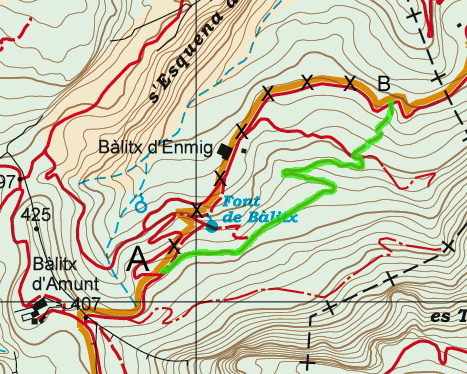
The country house of Bàlitx d'Enmig is under new ownership. Abundant notices point out that walkers should no longer pass the house. A new signposted and waymarked route offers a diversion. Before reaching Font de Bàlitx, the route now runs through olive groves above Bàlitx d'Enmig, offering better views than previously, and soon descends to rejoin the original route. See the map extract and follow the new route indicated in green between A and B. Do not follow the former route.
May 2019
Corrections
Refuge Booking Page 27:
The website for booking municipal refuges along the GR221 has changed. Please refer to https://seu.conselldemallorca.net/refugis/en/ruta/.
A small section of mapping was omitted from Alternative Start B. The corrected stage is available here.
183 184 (32.569 KB)
850 updates dealt with 6 4 17 (7.614 MB)
Free Royal Mail 48 postage on UK orders. European postage is £3.50 per item. Worldwide postage is £5.50 per item. If you're not happy with your purchase for any reason, we'll give you a full refund.
Learn moreDiscover the Cicerone App
The Cicerone App brings decades of expertise straight to your phone, making it easier than ever to plan and enjoy your adventures wherever you are. For use with In-App guides — not compatible with eBooks.


Popular related guides


