Walk the Reivers Way with a Cicerone guidebook
The Reivers Way
by Paddy Dillon
A handy pocket sized guidebook for anyone planning to walk the Reivers Way. Follow in the footsteps of the border reivers on this 150 mile route running from Corbridge to Alnmouth. The reivers route wanders through wild and scenic parts of Northumberland, and can be walked in 9 days. The book also includes variants and alternative routes. More...
Buy from Cicerone
Other eBook formats (more information)
Activities
walking, backpacking, trekking, bird-watching (Farne Islands)Seasons
spring can be the most attractive time; in summer accommodation needs to be booked ahead but Read More... ferries will be running to the Farne Islands; weather is less reliable in the autumn; in winter some accommodation providers will be closed and walking may be harder (in deep snow or after prolonged rain)Centres
Newcastle-upon-Tyne, Corbridge, Rothbury, Bamburgh, Alnwick, AlnmouthDifficulty
The Reivers Way is straightforward but sometimes the walk is remote and not specifically waymarked Read More... so navigation skills are required; terrain is varied; the route is described in 9 day stages but experienced long-distance walkers could tackle it in a weekMust See
North Pennines Area of Outstanding Natural Beauty; Hadrian’s Wall; Northumberland National Park; Read More... Cheviot Hills; Northumberland Heritage Coast; Farne Islands; dramatic castles and wild, empty landscapesThe Reivers Way is an ‘unofficial’ long-distance trail, wandering some 240km (150 miles) round the sparsely populated border county of Northumberland. While the popular Pennine Way and Hadrian’s Wall national trails run across Northumberland, the Reivers Way almost encircles the county, offering a wonderful opportunity to explore its wildest and most scenic parts. The route can be walked in nine days, and is suitable for an average walker, provided that they are reasonably competent with a map and compass. The route is not specifically waymarked beyond the usual public footpath and bridleway signposts, but the local authority has declared its intention to ensure that the paths are maintained in good order.
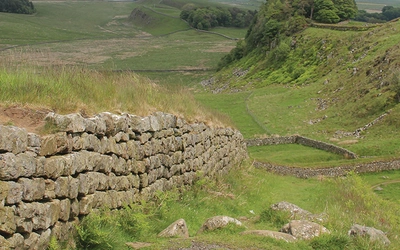
The trail starts at Corbridge and crosses Hexamshire Common in the North Pennines Area of Outstanding Natural Beauty. After following part of Hadrian’s Wall, a series of fine little towns and villages are visited, including Wark, Elsdon and Rothbury, as the route heads in and out of the Northumberland National Park. The broad and bleak Cheviot Hills are crossed on the way to Wooler. After catching a glimpse of Lindisfarne, the route traces the scenic Northumberland Heritage Coast from Bamburgh to Seahouses, then onwards to Craster and Boulmer to finish at Alnmouth. With an extra day to hand, walkers can include a boat trip to the bird reserves on the Farne Islands.
The Reivers Way is not based on any particular route used by reivers and ‘moss troopers’, but is simply a celebration of their memory, and a fine way to explore the land where they lived, and often died, in violent circumstances. When stripped of romance and glamour, reivers were little more than robbers and cattle rustlers living in a largely lawless society, but most of them had no option but to rob and raid in order to feed themselves and their families.
Brief History of a Borderland
Northumberland was forever destined to be ‘border country’ because of its position at the narrowest point of Great Britain. Evidence of human activity dates back 6000 years, and the region is well endowed with ancient settlement sites and ritual monuments. The Bronze Age and Iron Age were characterised by a noticeable level of strife, with many settlements built on defensive sites. A Celtic tribe, the Votadini, pushed southwards from Scotland, and was no doubt culturally distinct from other tribes already occupying the region.
Roman legions marched northwards through Britain between 55bc and 77ad, confidently claiming a complete conquest. However, while southern Britain was gradually Romanised, northern Britain rebelled. Any existing cultural border was well and truly reinforced with the building of Hadrian’s Wall from coast to coast in 122ad. There was another push northwards, resulting in the construction of the Antonine Wall in 142ad, but the legions had to pull back to Hadrian’s Wall in 160ad. It seems the Romans paid the Celtic Votadini to keep the Picts at bay to the north.
Under pressure from many sides, the Romans withdrew from Britain in 410ad. While Hadrian’s Wall is now in ruins, there is still a tangible feeling of being in ‘border country’ while following it. The Celts and Picts suffered as much from internecine strife as they did from fighting each other, and they were both overrun by Angles and Saxons.
Ida ‘the Flamebearer’ was an Angle who established a base at Bamburgh in 547ad. From this long-fortified rocky eminence he began to carve the foundations of a kingdom that became known as Northumbria, spreading far beyond current-day Northumberland. Successive Anglo-Saxon Northumbrian kings established a reasonable level of peace, while King Oswald encouraged Celtic Christian communities to flourish, spreading onto the mainland from Lindisfarne. Notable among the early churchmen were Aidan and Cuthbert. Danish invaders made incursions into the region, starting with an attack on Lindisfarne in 793ad. Later, the Scots also raided the region.
After the Norman Conquest another period of relative peace endured from the 11th to 13th centuries, with the Earls of Northumberland administering the region. Large-scale construction projects included castles and monasteries, especially along the coast and on the fertile lowlands. The death of Alexander III of Scotland in 1285, and the rise of Edward II of England, sowed the seeds of centuries of border strife. The local population found themselves under attack from all sides, with few they could truly call friends.
There was no convenient ‘border’ between England and Scotland drawn on the map, just a region of wild country that neither side could claim as their own, or hold against the other. Armies marched back and forth, demanding or appropriating provisions, so that the local population found itself reduced to poverty and starvation. They responded as desperate people always do, by going out and taking whatever they needed, from wherever they could find it.
The Borders were essentially lawless, but certain codes of conduct were observed, and the most enduring allegiances of all were bonds of blood between close family members. About one hundred surnames are recognised as ‘reiver’ family names, spanning the alphabet from Ainslie to Young.
Despite England and Scotland being locked in a state of permanent warfare for over three centuries, both nations had to tackle border lawlessness, so the region was divided into three ‘marches’. In Northumberland the problem was not simply English versus Scots across a fluid border, but reivers from Tynedale and Redesdale frequently raiding the fertile plains of Northumberland. Each march had two wardens – one English and one Scottish – to oversee rudimentary law and order. Scottish wardens were generally appointed from the local gentry, so had a good understanding of local issues, but were prone to corruption. English wardens were generally appointed from outside the area, so were less prone to corruption, but more inclined to misunderstand situations.
Peculiar border laws evolved, such as cross-border marriages being forbidden, on pain of death, without the agreement of both wardens. The tradition of ‘hot trod’ allowed, to someone whose cattle had been stolen, six days in which to recover his property. To do this he had to carry a burning peat on the tip of a lance and announce his intentions with ‘hue and cry, hound and horn’. This wouldn’t offer him any special protection, and he might be robbed, beaten, captured, ransomed or killed, but at least everyone knew why he was passing through. Anyone fleeing for their life could seek sanctuary in a church, while anyone who had committed heinous crimes could seek absolution at a monastery on payment of a fee! Protection rackets operated, and the English language derives words such as ‘blackmail’ and ‘bereaved’ from this era.
The Borders saw centuries of complex and deadly feuding, sometimes between English and Scots, sometimes between neighbouring families, and sometimes between factions within the same family. The wardens had to deal with frequent ‘bills’ – or complaints – so ‘truce days’ were held every 40 days or so to resolve differences. It was often the case that someone might be hanged before their trial took place, and if rope was scarce, drowning would suffice! Imprisonment was rarely an option due to lack of facilities, though a prison was eventually built at Hexham. Gammel’s Path, high in the Cheviot Hills, was one of the remote locations where ‘truce days’ were held.
The 16th century saw the peak period of reiving activity, when even the wardens were involved in the business of robbery and revenge. ‘Moss troopers’, as the reivers were sometimes known, rode stocky ponies for speed over rugged terrain, and wore rudimentary armour consisting of a steel helmet and leather jacket. For weapons they carried a lance and a sword, later supplemented with a pistol or two. After centuries of law-breaking, hunting and being hunted, it was a way of life that people were born into.
In 1525 the Archbishop of Glasgow pronounced an exceedingly lengthy, and remarkably comprehensive, blood-curdling curse on Scottish reiver families (see Appendix 4). On the English side, the preacher Bernard Gilpin spent his summers evangelising with great success among some of the roughest and toughest Northumberland communities, becoming known as the ‘Apostle of the North’.
Following the Union of Crowns in 1603, England and Scotland suddenly found themselves ruled by the same monarch, in the person of James I of England and VI of Scotland. This paved the way for a complete cessation of hostilities between both nations, but initially had little effect where the reiver lifestyle was ingrained in the population. Drastic action was required, and even the use of the word ‘Borders’ was forbidden, being replaced by the term ‘Middle Shires’. Families who refused to obey the law were rounded up and evicted, resettling in Ireland or North America. Those who accepted the law were rewarded with land, so that a measure of peace and prosperity settled on the region. The Union of the Parliaments was achieved in 1707, but the Borders saw a little more action during the Jacobite ‘risings’ of 1715 and 1745.
Rousing Borders ballads and the romantic stories penned by Sir Walter Scott cast a rosy hue on what must have been a most bloodthirsty period. One can only rejoice at the peace and tranquillity of the Northumberland countryside today, but also occasionally succumb to a few moments of melancholy while remembering the strife and senselessness of those troubled times.