


Walking on La Palma
Including the GR130 and GR131 long-distance trails


Walking on La Palma
Including the GR130 and GR131 long-distance trails
Guidebook to 45 walks and scrambles on La Palma in the Canary Islands, ranging from 7 to 31km. Some walks combine to complete the GR130 long-distance trail (8 days) and GR131 trail (3 days). Areas explored include Santa Cruz and Buenavista. Contains a Spanish-English glossary.La Palma is one of the greenest and most dramatic of the Canary Islands, home to the Caldera de Taburiente National Park, ancient laurisilva cloud forest, deep and rugged barrancos, and the highest peaks in the archipelago, including Roque de los Muchachos. With day walks and two long-distance trails, it rewards walkers of every ability with landscapes found nowhere else in the Canary Islands.
Written by prolific author Paddy Dillon, this second edition guidebook describes 34 day walks ranging from 6 to 32km (4 to 20 miles) and taking 2 to 10 hours, plus the GR130 and GR131 long-distance trails. It combines clear route descriptions with detailed information on planning, facilities, and public transport, giving you all the tools you need to explore La Palma.
- The 34 day walks cover the full island from Santa Cruz de La Palma and the Caldera de Taburiente national park to the Canary pine forests of Refugio del Pilar, Roque de los Muchachos, and the laurisilva cloud forest of Los Tilos
- The GR130, a circular long-distance walk around La Palma, is described in 8 stages covering 167km (104 miles), while the GR131 crosses the island's highest mountains in 3 stages over 68km (42 miles) and is part of the a longer route across all seven of the Canary Islands
- 1:50,000 maps are included for every walk alongside detailed information on planning, facilities, and public transport, with all routes waymarked and signposted and no special equipment required
- Background sections cover La Palma's geology, wildlife, and national parks alongside practical information on food and drink and a Spanish-English glossary
- Detailed accommodation information is provided throughout, with bases across the island including Santa Cruz de La Palma, Los Llanos, Fuencaliente, Refugio del Pilar, Tijarafe, and Barlovento
From the Caldera de Taburiente and the laurisilva cloud forest to the GR130 and the heights of Roque de los Muchachos, this second edition guidebook covers the full breadth of walking on La Palma.
Part of the 5-volume Cicerone series covering walking across all of the Canary Islands.
Walking on La Palma – Quick Facts
Island: La Palma, Canary Islands, Spain
Walk format: 34 day walks plus GR130 (8 stages) and GR131 (3 stages)
Day walk distances: 6 to 32km (4 to 20 miles) per walk
Day walk duration: 2 to 10 hours per walk
GR130: 8 stages, 167km (104 miles), circular route around La Palma
GR131: 3 stages, 68km (42 miles), crosses La Palma's highest mountains
Main centres: Santa Cruz de La Palma, Los Llanos, Fuencaliente, Refugio del Pilar, Tijarafe, Puntagorda, Garafía, Barlovento, Los Sauces, Puntallana
Key highlights: Caldera de Taburiente national park, Roque de los Muchachos, Canary pine forest, laurisilva cloud forest, deep barrancos, GR130, GR131
Difficulty: Short and easy to long, steep, and strenuous; all routes waymarked and signposted; no special equipment required
Best season: November to May; spring is especially colourful; summer is too hot; higher areas may see snow in winter
Maps: 1:50,000 maps included for every walk
Series: Part of the 5-volume Cicerone series covering the whole of the Canary Islands
Author Highlight
“La Palma is one of the smaller Canary Islands, at the western end of the archipelago. Its northern parts are heavily eroded, scored by dozens of steep-sided rocky barrancos. As a result, walks that lead in and out of them are often very rugged, but that shouldn’t suggest that the walking is going to be too difficult for ‘ordinary’ walkers. In fact, almost all the routes in this guidebook follow waymarked trails, made up of narrow paths and broad tracks that often zigzag to ease the gradient.”
- Paddy Dillon, author of Walking on La Palma
Printed book
A guidebook with detailed route descriptions, stage breakdowns, accommodation listings, profiles and maps - everything you need on the trail.
ISBN
9781852848538
Availability
Published
Published
11 Jan 2019
Edition
Second
Pages
240
Size
17.20 x 11.60 x 1.40cm
Weight
270g
eBook
The complete digital edition of the guidebook, with full route descriptions, accommodation listings, profiles and maps, ready to use on any device. To access your eBook, you will need an eReader app. For more details, visit the eBook FAQs.
Map key
Overview maps
Introduction
Location
Geology
Wildlife
National parks
The Fortunate Isles
Getting there
When to go
Accommodation
Health and safety
Food and drink
Language
Money
Communications
Walking on La Palma
Getting there
Getting around
What to take
Waymarking and access
Maps
Food and drink
Tourist information offices
Emergencies
Using this guide
The Walks
1 Santa Cruz and Lomo de las Nieves
2 Fuentes de Las Breñas
3 Buenavista and Pico de las Ovejas
4 Santa Cruz and Montaña de Tagoja
5 Pico de la Nieve to Santa Cruz
6 Santa Cruz to Puerto de Tazacorte
7 El Paso to Refugio del Pilar
8 Refugio del Pilar to Santa Cruz
9 Refugio del Pilar to Playa del Hoyo
10 Refugio del Pilar to Playa del Hoyo or La Salemera
11 Refugio del Pilar and Pico Nambroque
12 Jedey to Tigalate
13 San Nicolás and Coladas de San Juan
14 Llanos del Jable and Coladas de San Juan
Caldera de Taburiente
15 Pico Bejenado
16 La Cumbrecita to La Cancelita and Los Llanos
17 Barranco de las Angustias and Caldera de Taburiente
18 La Cumbrecita to Caldera de Taburiente
19 Caldera de Taburiente and Hoya Verde
20 Tijarafe and Porís de Candelaria
21 Tinizara to Piedras Altas and Tijarafe
22 La Traviesa: El Time to Briesta
23 La Traviesa: Briesta to Barlovento
24 La Zarza and Don Pedro
25 Roque del Faro to Garafía
26 Roque del Faro and Franceses
27 Roque del Faro to Roque de los Muchachos
28 Roque de los Muchachos to Puntagorda or Tijarafe
29 Pico de la Cruz to Barlovento
30 Pico de la Cruz to Los Sauces or Barlovento
31 Los Sauces and Los Tilos
32 Fuente de Olén to Las Lomadas
33 Fuente Vizcaína to La Galga
34 Pico de la Nieve to Puntallana or Tenagua
35 GR 130: Santa Cruz de La Palma to Mazo
36 GR 130: Mazo to Fuencaliente
37 GR 130: Fuencaliente to Los Llanos
38 GR 130: Los Llanos to Puntagorda
39 GR 130: Puntagorda to Garafía
40 GR 130: Garafía to Franceses
41 GR 130: Franceses to Los Sauces
42 GR 130: Los Sauces to Santa Cruz de La Palma
43 GR 131: Puerto de Tazacorte to Roque de los Muchachos
44 GR 131: Roque de los Muchachos to Refugio del Pilar
45 GR 131: Refugio del Pilar to Faro de Fuencaliente
Appendix A Route summary table
Appendix B Topographical glossary
Appendix C Useful contacts
Seasons
best between November and May, as the summer months are too hot, but it can sometimes snow on the higher parts; spring is especially colourful
Centres
Santa Cruz de La Palma, Los Llanos, Fuencaliente, Refugio del Pilar, Tijarafe, Puntagorda, Garafía, Barlovento, Los Sauces, Puntallana and the mountain road
Difficulty
routes vary from short and easy to long, steep and strenuous; all are waymarked and signposted, and no special equipment is required beyond ordinary walking gear, except when snow lies on the highest mountains
Must See
Caldera de Taburiente national park, Roque de los Muchachos, Canary pine forest, laurisilva 'cloud forest', deep and rugged barrancos, GR130 around La Palma, GR131 over the highest mountains
April 2025
Walk 1
While the lower part of this walk is fine, the longer upper extension to the walk has been closed off and can no longer be followed
November 2022
Volcán Tajogaite
Following the eruption of Volcán Tajogaite on the Cumbre Vieja on La Palma, almost half of the island's trails were closed as a precautionary measure. The situation is now much improved, with only a handful of trails close to the volcano still being closed. For full details of closures see the website www.senderosdelapalma.es/senderos/estado-de-los-senderos
The lava from Tajogaite severed the long-distance GR130, on Walk 37 in the guidebook, around Los Campitos. This remains closed.
When walkers reach Las Manchas, or San Nicolás, they should catch bus number 5 across the lava flow to La Laguna. This bus runs three times a day in each direction, Monday to Friday. However, by walking 5km downhill on roads to a restaurant at Las Norias, bus number 24 can be used to cross the lava to La Laguna, and this operates over a dozen times in both directions, every day of the week.
Please note that it is forbidden to walk or cycle along the road between Las Norias and La Laguna. The lava is still hot and vents toxic gases, so only buses and cars are allowed to use the road, without stopping. See the map, provided courtesy of Editorial Alpina, for the location of the new road.
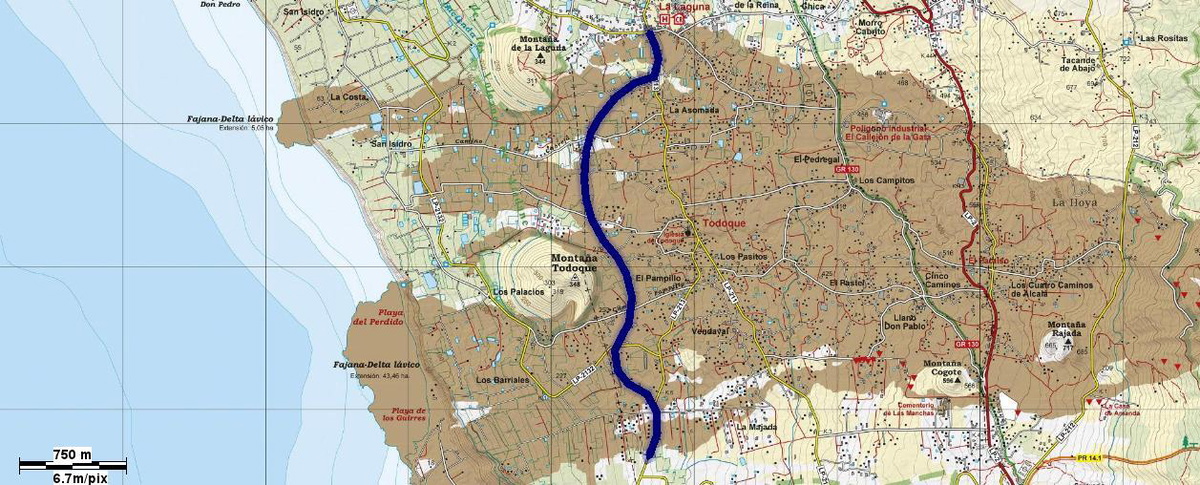
As a bonus, a new trail has been created, allowing walkers to reach safe viewpoints close to Tajogaite. See the map, provided courtesy of Editorial Alpina, for the location of the new trail.
Please note that it is necessary to join an authorised guided walk in order to use this trail. Go to the national park visitor centre above the town of El Paso and ask for details of any trips due to take place. The photo of Tajogaite from the new trail is used by kind permission of Jaume Tort.
The Editorial Alpina 1:25,000 map of La Palma is the most detailed map for walkers on La Palma. It shows all the waymarked trails and has been updated to show the extent of the lava flow from Tajogaite. Donations from the sale of this map are used to assist with ongoing relief on La Palma. www.editorialalpina.com/en/alpina-maps/canary-islands/
Free Royal Mail 48 postage on UK orders. European postage is £3.50 per item. Worldwide postage is £5.50 per item. If you're not happy with your purchase for any reason, we'll give you a full refund.
Learn moreDiscover the Cicerone App
The Cicerone App brings decades of expertise straight to your phone, making it easier than ever to plan and enjoy your adventures wherever you are. For use with In-App guides — not compatible with eBooks.


Popular related guides


