

John Hayes first came to know Spain on foot, walking 5,000km from Tarifa to Budapest, but it was on two wheels that he discovered the Ruta Vía de la Plata. His guidebook, Cycling the Ruta Via de la Plata, covers the 930km route from Seville to Gijón on the Atlantic coast, with a pilgrimage variant along the Camino Sanabrés to Santiago de Compostela. With road and off-road options throughout, the route links ancient cities, the vast landscapes of the meseta and dehesa, and the Cantabrian Mountains. Here, we talk to John about what makes this journey so special, how to choose between the road and off-road routes, and the one piece of advice he'd give to anyone setting off from Seville.
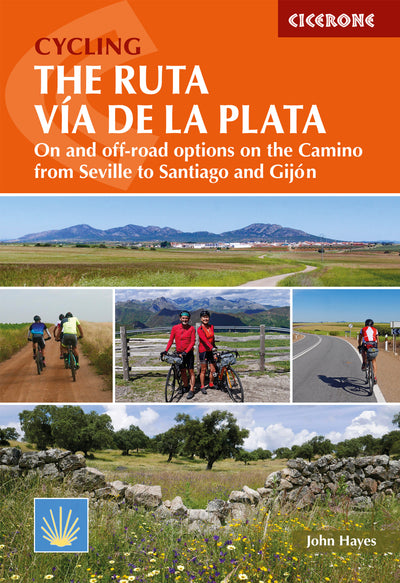
Cycling the Ruta Via de la Plata, quick facts:
- Route name: Ruta Vía de la Plata (Silver Route)
- Location: Western Spain
- Distance: 930km (Seville to Gijón); approximately 1,100km including the Camino Sanabrés to Santiago de Compostela
- Typical duration: Around 2 weeks for the main route
- Start: Seville
- Finish: Gijón (main route) or Santiago de Compostela (Camino Sanabrés variant) Route format: Linear long-distance cycle route
- Stages: 14 stages (main route); 6 additional stages for the Camino Sanabrés variant
- Key towns and cities: Seville, Zafra, Mérida, Cáceres, Plasencia, Salamanca, Zamora, León, Oviedo and Gijón; Ourense and Santiago de Compostela on the Camino Sanabrés
- Landscapes: Central plateau (meseta), dehesa woodland, Cantabrian Mountains
- Route options: Road and off-road alternatives described throughout; suitable for road, touring, hybrid and gravel bikes
- Difficulty: Accessible to a wide range of cyclists – empty roads and gentle climbs
- Best season: Spring and autumn; possible year-round
- Mapping: 1:150,000 colour maps for each stage, plus GPX files to download
- Accommodation: Pilgrim hostels, hotels and other options listed throughout
- Cycling the Ruta Via de la Plata is available as a printed guidebook or digital eBook.

Hi John! You've spent a lot of time exploring Spain on foot, including walking 5,000km from Tarifa to Budapest. What first drew you to Spain, and what made you want to explore it by bike?
On the second day of that walk to Budapest, I was lucky enough to meet a Spaniard who had walked every single Spanish GR route. Over the next few years, he guided me on a series of walks across Spain and provided an insider's introduction to various aspects of the country's history and culture. In particular, he cultivated in me a deep appreciation of the Spanish lifestyle, noisy and very communal, and best experienced in the early evening in the plaza mayor, every town's main square. I'm a touring cyclist, and for me, cycling in Spain is a way to see more of the country than I've been able to on foot.
The Ruta Vía de la Plata follows a historic route with Roman origins and a long association with pilgrimage. What makes it so fascinating, both as a cycling route and as a way to experience Spain's history?
It's the places connected by the Ruta Vía de la Plata that make it so special. Many of the daily destinations on a two-week tour would justify a trip to Spain on their own. Cycling the route means you can arrive for a late lunch and still have enough time to explore the sites and enjoy tapas in the main square. The country's history is laid out almost like geology in its buildings, many built on Roman foundations and later repurposed by the Visigoths, Muslims and Christians after the Reconquest.
Your guide covers two endings: north to Gijón, or west along the Camino Sanabrés to Santiago de Compostela. How do the two journeys differ, and how should cyclists choose?
Both options are brilliant. If you have never done a pilgrimage route or you want to bag a different one, head west and finish at Santiago de Compostela, a special place. The western route is a little more remote and means missing out on León and Oviedo, plus some wonderful cycling across the Cantabrian Mountains. León is my favourite city on the route; it has an amazing parador (hotels generally located in historic buildings), and the stained glass in the cathedral's windows is regarded by many as the world's best.

The guide offers road and off-road routes, with options to combine the two. How did you approach planning these alternatives, and what would you say to someone unsure which to follow?
My guide includes a road route, an off-road route, and a recommended route for touring cyclists. The road route is the N-525, and for Spanish car drivers it is the Ruta Vía de la Plata. In UK terms, N routes are the equivalent of A roads, and the national network was developed after the Second World War. Because Spain now has a brand-new motorway network, N routes, particularly the N-525, are generally empty and serve local traffic. The off-road route follows the original historic route used by the Camino and includes occasional Roman mile markers; it also benefits from the yellow-arrow Camino waymarks. The Camino generally follows agricultural-style dirt roads, but occasionally the route doesn't work for cyclists, and the guide includes a recommended alternative.
You describe the Ruta as accessible to a wide range of cyclists. What kind of cycling experience can people expect, and what level of fitness or preparation do you recommend?
Cyclists come in all shapes and sizes, but you need some cycling confidence for a 14-day trip. The cycling isn't that challenging, and you can swap the steeper off-road sections for a road route along the carefully graded N-525, built for lorries in the 1950s. Nearly all the days can be completed in 4 hours or less on the saddle, and the biggest challenge is finding accommodation at the end of each stage and navigating the one-way systems in the ancient town centres.
The route passes through Seville, Mérida, Cáceres, Salamanca and Zamora, as well as the vast landscapes of the meseta and dehesa. Was there a place or stretch that surprised you or stayed with you long after the ride?
My most distinct memory, and the best thing, was cycling through the dehesa. The dehesa is a special landscape characteristic of southern Spain. Historically, it dates back to the 14th century, after the Reconquest, when the countryside was divided into large landholdings. These landholdings were farmed in a ranch style with very few people and a lot of cattle, sheep and pigs (the famous Cerdo Ibérico used for the best Spanish ham). The dehesa resembles an enormous park of scattered dark evergreen oaks that shelter the animals, with grazing land in between that is full of flowers in spring and turns burnt ochre in autumn. The best stretch is near Plasencia, and cycling through it is unforgettable.

Food, accommodation and the towns along the way are a big part of the experience. What were the highlights, and what should cyclists look out for?
Food and drink are good value in Spain, and it's the cheapest place to find accommodation in former palaces. Particularly good are the paradors in Plasencia and León. The cuisine does change as you head north, but it helps if you like ham, with every town claiming to have the best tapas and the best ham in Spain. For tapas and people-watching, always head for the Plaza Mayor, where the two come together.
What are the most important things cyclists should think about before setting off?
If you're new to cycle touring, the biggest challenge may be transporting a bike to and from Spain, especially as the journey starts and finishes in different places. My own approach has evolved over time, and the only time I've had a problem was when I used a courier and for some reason, still unknown, the bike didn't arrive. Now I always take the bike with me on the plane, tightly packed in a soft bag, and carry the bag on the bike for the return trip home.
If taking your bike in a soft bag through an airport feels like too big a step into the unknown, hiring a bike in Spain is a practical alternative. You can have bikes delivered to your hotel at the start of the journey and picked up at the end, and you can choose from a range of bikes, including an e-bike, which you can't take on a plane.
You worked with the Ruta Vía de la Plata Association and drew on local knowledge along the route. Did anything you learned change your understanding of the journey, or how you described it?
The Association is formed of all the town and city councils along the route and was incredibly helpful. They recommended hotels and restaurants, and in each town a local from the tourist information office met me, took me round the main sights, and usually took me out for dinner. It was a great privilege and, to be honest, I was a little spoiled. Tourism in Spain is very well organised at all levels of government, but the Association is particularly interesting, built as it is from the bottom up with locals keen to show what makes each of their towns special. Hopefully this has come through in the guide. Although there are some common historical themes, each town and city has something unique, and the locals helped me find it.
Finally, would you recommend the Ruta Vía de la Plata as a first long-distance cycling adventure in Spain? What one piece of advice would you give to someone about to set off from Seville?
Definitely! The only problem with choosing the Ruta Vía de la Plata as your first long-distance cycling trip is that the second one will almost certainly be a disappointment. The cycling is great, not too difficult, but the destinations, the towns and cities, are just amazing. Be careful about when you go, what time of year. Seville is in Spain's hot deep south, and the route takes you north to the Cantabrian Mountains, where it's green and wet. The Ruta Vía de la Plata is an ideal "shoulder" destination, either side of the summer: late April, May and June, or September and October.
About the guidebook author, John Hayes:
John Hayes is a retired management consultant with degrees from Liverpool University and University College London. Immediately after finishing work in 2011 he embarked on an epic 5,000km trek across Europe, walking from Tarifa in Spain to Budapest. John has written for numerous walking and trekking magazines, and has written four walking guides and a cycling guide for Cicerone.


