Cycling La Vélodyssée: a complete planning guide
La Vélodyssée is a 1302km cycling odyssey along the Atlantic coast of France, following the French section of EuroVelo 1 from the Channel port of Roscoff in Brittany to Hendaye on the Spanish border. The waymarked route, 80% of it on traffic-free paths, travels through three distinct regions: the agricultural uplands and canal country of Brittany; the drained marshlands, historic ports, and oyster beds of the Atlantic seaboard; and the great pine forests, sand dunes, and surf coast of Aquitaine. Described in 19 stages with an average of 75km per day, La Vélodyssée is suitable for cyclists of all levels and can be ridden in its entirety or as three separate one-week tours. (Last updated: June 2026 · Guidebook edition: 1st edition, 2026)
Cycling La Vélodyssée, quick facts:
- Location: Atlantic coast of France, from Roscoff (Brittany) to Hendaye (Basque Country)
- Total distance: 1302km
- Total ascent/descent: 4760m
- Number of stages: 19 (based on ~75km per day)
- Suggested duration: 19 days (standard), 14 days (faster, ~95km/day), or 28 days (slower, ~50km/day)
- Traffic-free: 80% of the route on dedicated cycle paths and towpaths
- Route: EuroVelo 1, La Vélodyssée (fully signposted)
- Terrain: Canal towpaths, coastal cycle paths, forest tracks, quiet lanes, and some stony tracks
- Best bikes: Gravel or touring bikes recommended; all bikes except narrow-tyred road racing bikes and full-suspension mountain bikes are suitable; e-bikes well suited
- Best season: April to October; peak conditions May, June, September
- Natural break points: Nantes (end of Section 1) and Royan (end of Section 2) divide the route into three one-week tours
- Guidebook:Cycling La Vélodyssée by Jack Jackson, 1st edition
- App: The guide optimised for mobile in the Cicerone App
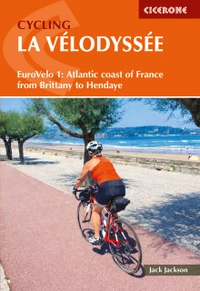
Cycling La Velodyssee
EuroVelo 1: Atlantic coast of France from Brittany to Hendaye
£18.95
Guidebook to cycling La Vélodyssée, a 1300km route skirting the Atlantic coast of France from Roscoff in Britanny to Hendaye on the Spanish border. Described in 19 stages with suggested itineraries of 8 to 36 days, La Vélodyssée is suitable for all bike types, with 80% of the route on traffic-free paths. With 1:200,000 mapping and free GPX files.
More information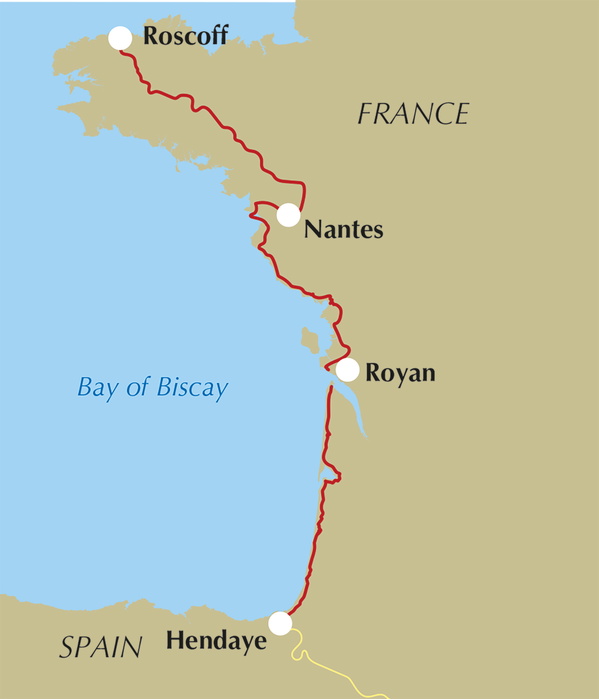
What is La Vélodyssée?
La Vélodyssée is the French section of EuroVelo 1, the European Atlantic Coast Route, which runs for 11,000km from North Cape in Norway to Sagres in Portugal. The French section follows the Atlantic coast from Roscoff in northern Brittany to Hendaye at the Spanish border, covering 1302km through three regions that capture both the essence of France and its considerable variety.
The route divides naturally into three sections, each around one week's riding. The first crosses Brittany from north to south, following a disused railway line across the agricultural uplands before joining the towpath of the Nantes–Brest canal, passing through medieval towns and past ancient castles to arrive at the banks of the Loire. The second follows the wild Atlantic coast through the drained marshland of Loire Maritime, Vendée, and Charente, taking in the historic ports of La Rochelle, Rochefort, and Royan. The third, south of the Gironde estuary, weaves through massive sand dunes and pine forests alongside world-class surfing beaches before reaching the glitzy resorts of the Basque Country.
With 80% of the route on traffic-free paths and a generally gentle profile, La Vélodyssée is accessible to cyclists of any level. The excellent transport links, abundant accommodation, and outstanding regional food make it one of the most rewarding long-distance cycle routes in Europe. For complete stage descriptions and 1:200,000 mapping for all 19 stages, see the Cicerone Cycling La Vélodyssée guidebook.
What are the stages of La Vélodyssée?
The route is divided into three geographic sections. Each section takes approximately one week at the standard pace of around 75km per day.
| Section | Stages | Distance | Total ascent |
|---|---|---|---|
| Brittany (Roscoff to Nantes) | 1–6 | 390.2km | 1860m |
| Pays de la Loire, Vendée and Charente-Maritime (Nantes to Royan) | 7–13 | 497.4km | 1340m |
| Aquitaine (Royan to Hendaye) | 14–19 | 414.6km | 1560m |
| La Vélodyssée total | 1–19 | 1302.2km | 4760m |
Brittany (Stages 1–6) is the most varied section in terms of terrain. Stage 1, from Roscoff to Carhaix-Plouguer (79.9km, 790m ascent), is the longest and most challenging in the book, following a disused railway across the agricultural uplands. Stages 2–5 join the Nantes–Brest canal towpath, passing through Carhaix-Plouguer, Mûr-de-Bretagne, Josselin, and Redon in a series of comfortable days of 62–73km. Stage 6 is the shortest in the section (38.7km), dropping easily into Nantes. The section totals 390.2km and 1860m of ascent.
Pays de la Loire, Vendée and Charente-Maritime (Stages 7–13) is the flattest and longest section by distance. The route leaves Nantes and follows the Atlantic coast south, with Stage 10 (Saint-Gilles-Croix-de-Vie to La Tranche-sur-Mer, 81.5km) the longest in the book. The section passes through Vendée marshland, the Île de Noirmoutier, the historic port of La Rochelle, and Rochefort before finishing at Royan on the Gironde estuary. The section totals 497.4km and 1340m of ascent, the gentlest of the three.
Aquitaine (Stages 14–19) crosses the Gironde by ferry and enters the Landes de Gascogne, a vast landscape of maritime pine forest and sand dunes. The section includes the most scenic coastal riding of the route, alongside the great surf beaches of Lacanau, Arcachon, and the Côte Basque, before finishing at Hendaye. Stage 19 (Bayonne to Hendaye, 51.7km) is the shortest stage in the book, with the most ascent in the section (490m) as the route navigates the hilly Basque terrain. The section totals 414.6km and 1560m of ascent.
| Stage | Time | Distance (km) | Ascent/Descent (m) |
|---|---|---|---|
| Brittany | - | - | - |
| 1 Roscoff to Carhaix-Plouguer | 6hr 30min | 79.9 | 790/660 |
| 2 Carhaix-Plouguer to Mûr-de-Bretagne | 3hr 45min | 64.3 | 360/350 |
| 3 Mûr-de-Bretagne to Josselin | 3hr 45min | 72 | 220/330 |
| 4 Josselin to Redon | 3hr 50min | 62.8 | 180/210 |
| 5 Redon to Nort-sur-Erdre | 4hr 25min | 72.5 | 110/110 |
| 6 Nort-sur-Erdre to Nantes | 2hr 30min | 38.7 | 200/200 |
| Section 1 total | 24hr 50min | 390.2 | 1860/1860 |
| Pays de la Loire, Vendée and Charente-Maritime | - | - | - |
| 7 Nantes to Saint-Brevin-les-Pins | 3hr 45min | 61.3 | 180/180 |
| 8 Saint-Brevin-les-Pins to Bouin | 4hr 35min | 76.8 | 330/330 |
| 9 Bouin to Saint-Gilles-Croix-de-Vie | 4hr 30min | 72.6 | 130/130 |
| 10 Saint-Gilles-Croix-de-Vie to La Tranche-sur-Mer | 5hr 10min | 81.5 | 240/240 |
| 11 La Tranche-sur-Mer to La Rochelle | 3hr 45min | 71.5 | 80/80 |
| 12 La Rochelle to Rochefort | 2hr 35min | 50 | 120/120 |
| 13 Rochefort to Royan | 4hr 40min | 83.7 | 260/260 |
| Section 2 total | 29hr | 497.4 | 1340/1340 |
| Aquitaine | - | - | - |
| 14 Royan to Lacanau-Océan | 4hr 40min | 84.3 | 260/250 |
| 15 Lacanau-Océan to Arcachon | 4hr | 80.1 | 130/140 |
| 16 Arcachon to Gastes | 3hr 35min | 66.2 | 300/280 |
| 17 Gastes to Léon | 4hr | 70.4 | 250/250 |
| 18 Léon to Bayonne | 3hr | 61.9 | 130/150 |
| 19 Bayonne to Hendaye | 3hr | 51.7 | 490/490 |
| Section 3 total | 22hr 15min | 414.6 | 1560/1560 |
| La Vélodyssée total | 76hr | 1302.2 | 4760/4760 |
How long does it take to cycle La Vélodyssée?
The guidebook describes the route in 19 stages based on an average of approximately 75km per day, taking most cyclists between 3 and 6 hours in the saddle. Two alternative itineraries are also provided:
- 19 days (standard): approximately 75km per day, 3–6hr cycling daily
- 14 days (faster): approximately 95km per day
- 28 days (slower): approximately 50km per day
The three natural break points at Nantes and Royan also allow La Vélodyssée to be completed as three separate one-week tours rather than a single continuous journey. Each week-long section has its own distinct character and is self-contained.
For those with less experience of multi-day cycling, a useful preparation strategy is to do a few day rides of increasing length in the weeks before departure, to find the daily distance that suits you and can be sustained across multiple days.
What kind of bike do you need?
The best bike for La Vélodyssée is the one you already own. The route is suitable for all bikes except narrow-tyred carbon road racing bikes (which will struggle on some stony tracks) and full-suspension mountain bikes (which add unnecessary weight for a largely flat route). A modern gravel bike with a good range of gears, a lightweight frame, drop handlebars, and medium tyre width is the optimum choice. La Vélodyssée is also very well suited to e-bikes.
Whichever bike you take, it should be in good working order before you set off. The two mechanical problems most likely to halt a ride without warning are a puncture and a broken chain. Carry a puncture repair kit appropriate for your tyre type, a spare inner tube, and a chain link extraction tool. Lubricate your chain at the start of each day, and clean your bike regularly — the sandy trails and salty air are hard on components. There is good provision of cycle shops along the route for advice and repairs.
For carrying kit, there are three main options: lightweight bikepacking bags fixed to the seat post, crossbar, and handlebar; traditional front and rear panniers on a rack; or a bike trailer. Each has trade-offs in terms of weight, manoeuvrability, and capacity. Backpacks are not recommended for carrying anything other than the lightest items.
When is the best time to cycle La Vélodyssée?
La Vélodyssée can be cycled year-round, but April to October offers the best conditions. As the route travels south, temperatures are 3–4°C warmer on Stage 19 than on Stage 1. At Biarritz, near the end of the route, temperatures reach the mid-twenties in July, August, and September, and the high teens in May, June, and October.
- Spring (April to June) is an excellent time to ride: comfortable temperatures, low crowds, all campsites and accommodation open, and the beaches and coastal paths at their most rewarding before the summer peak.
- Summer (July to August) brings warm temperatures and the full tourist infrastructure, but also the highest crowds at popular coastal stops. The beaches are at their most lively, which suits cyclists who want to combine cycling with beach time.
- September and October offer the best conditions of all for many cyclists: warm but not hot, quieter than midsummer, and with some seasonal accommodation still open. October is the cut-off for many ferry and campsite services.
- Winter (November to March) is possible for hardier cyclists, but lower temperatures, stronger winds, more frequent rain, and the closure of seasonal accommodation and services make it significantly less attractive.
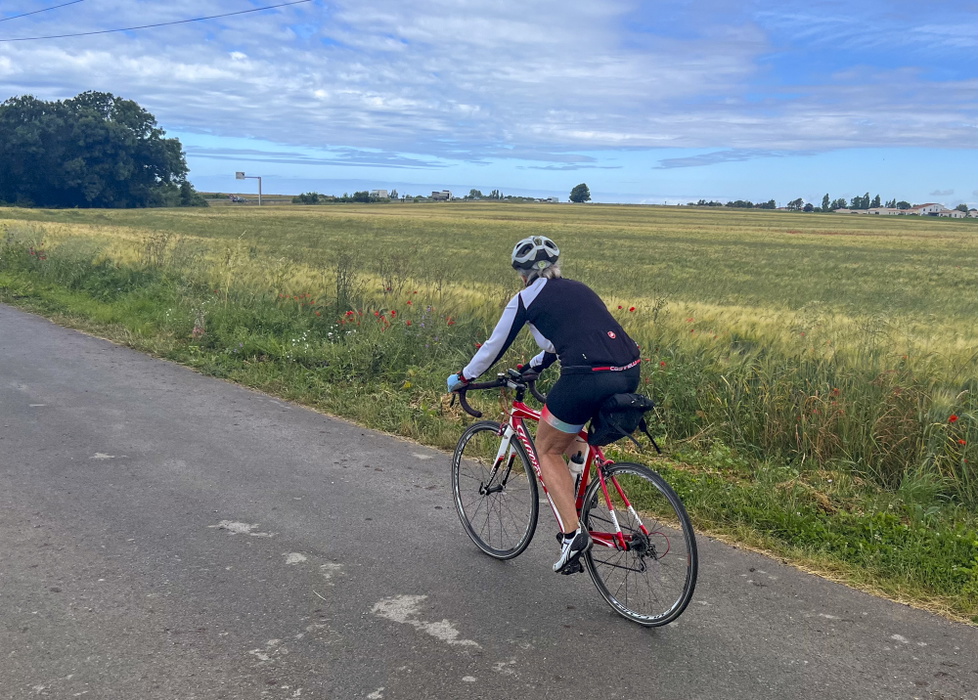
How do I get to the start and home from the finish?
Getting to Roscoff: The most straightforward route for UK and Irish cyclists is by sea with Brittany Ferries, which carries bikes at no extra charge. From Plymouth, sailings run from April to November (5 hours in the afternoon, or overnight). From Cork, a 15-hour crossing runs from March to October. By train, a direct TGV from Paris-Montparnasse reaches Morlaix (30 minutes from Roscoff by bus) in approximately 3 hours. It is also possible to reach Morlaix from London via Eurostar and Paris in under 8 hours. Bikes travel in a reservable space on the TGV (two per train); book when purchasing your ticket.
Natural break points: For cyclists tackling the route in sections, Nantes is 2 hours from Paris by TGV and has an international airport with direct flights to most European countries. Royan is 4 hours from Paris by train and 2 hours from La Rochelle. Les Sables-d'Olonne, roughly halfway through Section 2, is 4 hours from Paris and 90 minutes from Nantes.
Getting home from Hendaye: Hendaye is 5 hours from Paris by TGV and 10 hours from London via Eurostar. For those returning by sea, Bilbao is 160km by bike or 2 hours by bus from Hendaye, with Brittany Ferries sailing to Portsmouth and Rosslare. San Sebastián Airport is a flat 5km ride from Hendaye, with direct flights to Madrid and UK airports.
What are the highlights of cycling La Vélodyssée?
- The Nantes–Brest canal towpath (Stages 2–5) is the heart of the Brittany section: a serene and largely flat waterway threading through medieval towns past ancient lock-keepers' cottages, with kingfishers, herons, and otters along the banks. The towpath provides some of the most pleasant and effortless cycling on the entire route.
- La Rochelle (Stage 11 finish) is one of the finest historic ports in France, with a medieval harbour guarded by two towers, excellent seafood, and a rich cycling culture. The city is a natural rest day stop.
- The Marennes Oléron oyster beds are a defining feature of the Charente-Maritime coastline, with 24-hour oyster vending machines and waterside producers selling directly to passing cyclists.
- The Gironde crossing by ferry between Royan and the Médoc is one of the great moments of La Vélodyssée, the wide river mouth marking the transition from the Atlantic seaboard to the pine forests and surf coast of Aquitaine.
- The Landes de Gascogne (Stages 14–17) is a vast and hypnotic landscape: 200km of maritime pine forest and sand dunes stretching along the coast, with long stretches of traffic-free cycling alongside the great surf beaches of Lacanau and Mimizan.
- The Basque Country (Stages 18–19) brings the route to a dramatic conclusion, with the resort towns of Biarritz and Saint-Jean-de-Luz, Basque cuisine and architecture, and the finish at Hendaye on the Spanish border.
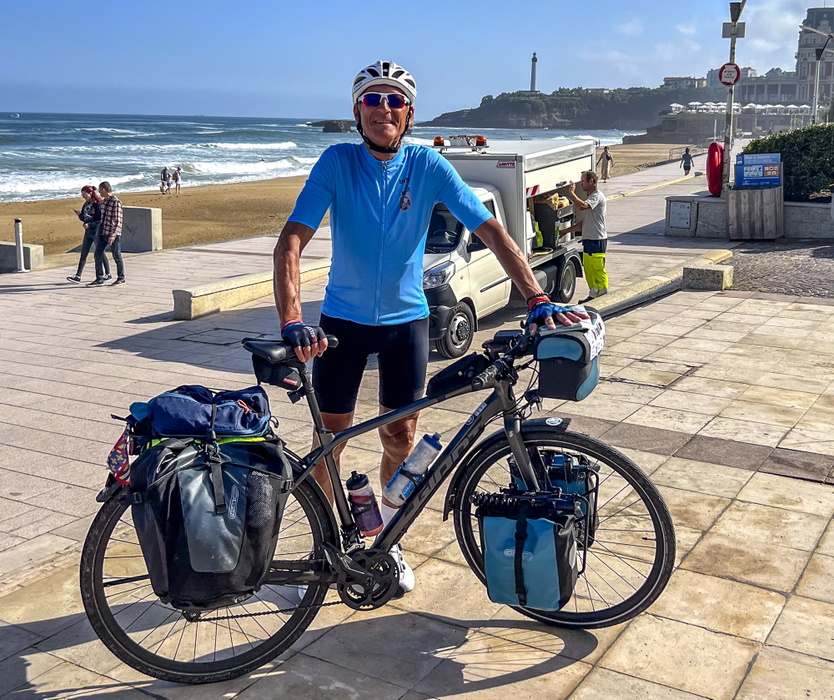
What is the food and drink like on La Vélodyssée?
France offers some of the finest cycling cuisine in the world, and La Vélodyssée passes through three regions each with their own strong culinary identity.
In Brittany, look out for savoury galettes (buckwheat pancakes) and sweet crêpes, kouign-amann (crispy caramelised pastry), Far Breton (a dense custard cake with dried fruit), and cidre in its dry, sweet, or demi-sec varieties. In the Atlantic seaboard section, the cuisine is dominated by the sea: Marennes Oléron oysters (raw with lemon), moules-frites, sardines direct from the La Perle des Dieux canning factory at Saint-Gilles-Croix-de-Vie, and jambon de Vendée paired with mogette de Vendée white beans. In the Basque Country, try jambon de Bayonne, axoa d'Espelette (a veal and chilli stew), zikiro (barbecued suckling lamb), and the gâteau Basque filled with Itxassou cherry jam.
For drinks, the route passes through two of France's great wine regions: Muscadet from around Nantes, perfect with oysters, and Bordeaux from around the Gironde. In Brittany, cidre is as popular as beer. Cyclists finishing in Hendaye should seek out Izarra, a Basque distillate of plants and spices produced in the town at the end of the route.
What accommodation is available along La Vélodyssée?
Accommodation along La Vélodyssée ranges from budget campsites to comfortable hotels in former palaces, and the route passes through regions with some of the best tourism infrastructure in Europe. The guidebook lists accommodation options at or near the end of each stage, though the listing is not exhaustive and fuller listings are available on local tourist office websites (Appendix A).
On most stages, accommodation is abundant and there is rarely a problem finding a place to stay without booking far in advance. Stage 8 (Saint-Brevin-les-Pins to Bouin) is one exception where accommodation at the stage end is limited; the guidebook notes this and suggests extending or finishing the stage early if a specific type is required.
A notable low-cost option is Warm Showers (warmshowers.org), a contact-sharing website where fellow cyclists offer free accommodation to cycle tourists, ranging from camping in a garden to a spare room. Many cyclists use this as a supplement to paid accommodation across the route.
How does La Vélodyssée connect to other routes?
La Vélodyssée is well connected to other long-distance cycling adventures:
- EuroVelo 1 extends La Vélodyssée north to South Cape in Norway (11,000km total) and south to Sagres in Portugal
- Loire à Vélo connects at Nantes, following the River Loire cycle route east to the Atlantic
- Canal des Deux Mers begins at Royan, linking the Atlantic to the Mediterranean
- Camino de Santiago is a day's ride from Hendaye, with Saint-Jean-Pied-de-Port the traditional starting point for the Camino Francés across northern Spain
- A vast web of regional waymarked cycleways intersects La Vélodyssée throughout, allowing the route to be personalised
Plan your ride with the Cicerone guidebook
The Cicerone Cycling La Vélodyssée guidebook by Jack Jackson contains everything you need to plan and complete all 19 stages of the route.
- 19 stage descriptions with 1:200,000 mapping and urban maps at 1:40,000
- Route summary table listing all 19 stages by distance, ascent, descent, and time
- Stage facilities planner at the front of the book, covering accommodation, campsites, shops, cafés, and restaurants at each stage end
- Three alternative itineraries for 14-day, 19-day, and 28-day schedules
- Free GPX files available to download at cicerone.co.uk/1274 for anyone who has bought the guidebook, and via the Cicerone app for GPS-enabled offline navigation
- Accommodation listings (Appendix A) for providers along the route
- What to take checklist (Appendix B) covering clothing, camping, cooking, and essential personal items
- Useful contacts (Appendix C) for transport, tourism, and cycling organisations
- Connections to other routes (Appendix D) including EuroVelo 1, the Loire à Vélo, and the Canal des Deux Mers
Available as a printed guidebook (£18.95), digital eBook (£18.95) or optimised for mobile on the Cicerone App (£9).
Cycling La Velodyssee
EuroVelo 1: Atlantic coast of France from Brittany to Hendaye
£18.95
Guidebook to cycling La Vélodyssée, a 1300km route skirting the Atlantic coast of France from Roscoff in Britanny to Hendaye on the Spanish border. Described in 19 stages with suggested itineraries of 8 to 36 days, La Vélodyssée is suitable for all bike types, with 80% of the route on traffic-free paths. With 1:200,000 mapping and free GPX files.
More informationAbout Jack Jackson, guidebook author:
Jack Jackson started creating adventures for himself as a teenager, hitchhiking to North Wales for rock-climbing weekends, and has not stopped since — whether on a crag, in the mountains, on the trail, on skis, in a kayak, or on a bike. With his love of self-supported journeying, Jack has undertaken many bike odysseys, including the Hebridean Way, the C2C, Lôn Las Cymru, King Alfred's Way, the Kjölur Route in Iceland, the Wolf's Lair in Italy, and La Vélodyssée itself. Having worked as a climbing instructor, maths teacher, secondary school headteacher, and CEO of a Multi-Academy Trust, Jack now spends his time planning, undertaking, and writing about his adventures in the outdoors.