Camino de Santiago – Camino Francés: a complete planning guide
The Camino Francés is the most legendary, most travelled, and most revered of the Camino de Santiago's many routes. The 'French Way' begins on the French slopes of the Pyrenees at Saint-Jean-Pied-de-Port, crosses northern Spain through the vine-covered valleys of Navarre and La Rioja, out across the vast grain plains of the Meseta, past the great Gothic cities of Burgos and León, over the mountains of the Bierzo, and into the lush green hills of Galicia before arriving at the ancient pilgrimage city of Santiago de Compostela. Sandy Brown's guidebook describes the full 784km route in six sections and 36 customisable stages, with extensions to the Atlantic coast at Finisterre and Muxía, covering over 500 pilgrim hostels and everything needed to plan and complete one of the world's great long-distance walks. (Last updated: June 2026 · Guidebook edition: 2nd edition, 2025)
The Camino de Santiago - Camino Francés, quick facts:
- Location: Northern Spain, from Saint-Jean-Pied-de-Port (France) to Santiago de Compostela (Galicia)
- Total distance: 784km (Saint-Jean to Santiago); extensions to Finisterre (91km) or Muxía (87km) add 3–4 days
- Sections: 6 (plus the optional Finisterre/Muxía extension)
- Stages: 36 customisable stages
- Suggested duration: 32–39 days (Saint-Jean to Santiago) at 20–25km per day, plus 3–4 days for the ocean extension
- Terrain: Dirt paths, gravel farming tracks, quiet country roads, and some asphalt; three mountain crossings above 1200m
- Starting options: Saint-Jean-Pied-de-Port, Roncesvalles, Pamplona, Burgos, León, Ponferrada, O Cebreiro, or Sarria (minimum 100km for a compostela)
- Navigation: Yellow arrows throughout; well signposted
- Best season: Spring (March to June) and autumn (September to October); summer is peak season with larger crowds; winter is possible but demanding
- Credencial: Required for albergues and compostela; available from national confraternities or along the route for €3–5
- Guidebook:Camino de Santiago: Camino Francés by Sandy Brown, 2nd edition
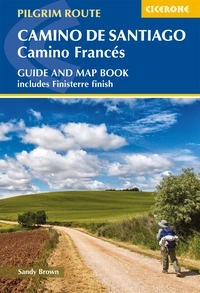
Camino de Santiago: Camino Frances
Guide and map book - includes Finisterre finish
£17.95
Guidebook and map book to walking the 784km Camino Frances from St Jean-Pied-de-Port in southern France to Santiago de Compostela in Spain, including an additional route to Finisterre. Split into 6 sections and 36 customisable stages, the guide lists over 500 pilgrim hostels. The map book covers the entire route, which can be walked in 4-5 weeks.
More information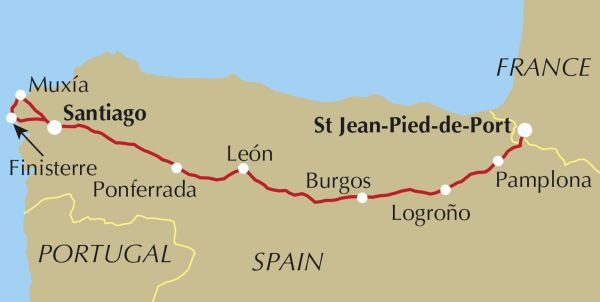
What is the Camino Francés?
The Camino Francés is the main route of the Camino de Santiago — 'the Way of St James' — a Christian pilgrimage to the shrine of the Apostle James in the Cathedral of Santiago de Compostela in northwest Spain. Of the Camino's many tributaries, the French Way is the longest established, the most heavily travelled, and by almost universal agreement the most complete pilgrimage experience available today.
Every year well over 300,000 pilgrims walk, cycle, or ride on horseback to Santiago de Compostela, crossing mountain ranges, wide river valleys, medieval cities, and the vast agricultural heartland of the Spanish meseta. The route is both ancient and alive: the yellow arrows that mark it were painted in 1969 by a Galician priest using surplus highway paint, and the million-step drumbeat of modern pilgrims follows a path worn into the soil by over a thousand years of continuous pilgrimage.
The Camino Francés is open to all, regardless of religious affiliation or physical ability. People come from every country in the world and with every motivation: spiritual renewal, physical challenge, grief and recovery, friendship, adventure, or simply a desire to walk somewhere meaningful. Sandy Brown's guidebook covers the complete route from Saint-Jean-Pied-de-Port to Santiago, with optional extensions to Finisterre and Muxía on the Atlantic coast. For complete stage descriptions, maps, and accommodation listings for all 36 stages, see the Cicerone Camino de Santiago: Camino Francés guidebook.
The six sections at a glance
The guidebook divides the Camino Francés into six geographic sections, each with its own character. Stage planning tables in Appendix A allow pilgrims to customise their daily distances based on their own walking pace.
| Section | Route | Distance | Walking days |
|---|---|---|---|
| 1: Saint-Jean-Pied-de-Port to Pamplona | Saint-Jean – Roncesvalles – Zubiri – Pamplona | 68km | 3 or more |
| 2: Pamplona to Burgos | Pamplona – Puente la Reina – Estella – Logroño – Nájera – Santo Domingo de la Calzada – Burgos | 220km | 9 or more |
| 3: Burgos to León | Burgos – Hontanas – Boadilla del Camino – Carrión de los Condes – Mansilla de las Mulas – León | 183km | 7 or more |
| 4: León to Sarria | León – Astorga – Foncebadón – Ponferrada – Villafranca del Bierzo – O Cebreiro – Sarria | 196km | 8 or more |
| 5: Sarria to Santiago de Compostela | Sarria – Portomarín – Palas de Rei – Arzúa – O Pedrouzo – Santiago | 117km | 5 or more |
| 6: Santiago to Finisterre or Muxía* | Santiago – Negreira – Olveiroa – Finisterre / Muxía | 91 or 87km | 3 or more |
*Optional extension to the Atlantic coast
Section 1: Saint-Jean-Pied-de-Port to Pamplona (Stages 1–3, 68km) opens with the Camino's most dramatic day: the climb over the Pyrenees on the Route Napoléon (or the lower Valcarlos route in dangerous winter conditions) before descending to the great monastery of Roncesvalles. The section continues through the wooded Basque foothills to Pamplona, the city of the running of the bulls.
Section 2: Pamplona to Burgos (Stages 4–12, 220km) is the longest section and the one that defines many people's image of the Camino: medieval pilgrim towns strung across broad valleys of vines and grain, the Alto del Perdón ridge, the wine-producing towns of La Rioja, and the breathtaking Gothic cathedral at Burgos. Cruz de Ferro, where pilgrims leave a stone as a symbolic release of burdens, lies ahead in Section 4.
Section 3: Burgos to León (Stages 13–19, 183km) is the Meseta — the vast, flat-ish plateau at around 800m elevation that divides pilgrims into those who find it monotonous and those who find it profoundly beautiful. The grain fields stretch for miles, the days are long and quiet, and the pace of walking slows to something closer to meditation.
Section 4: León to Sarria (Stages 20–27, 196km) is the most varied section: two more days to explore León's extraordinary cathedral before the climb to Cruz de Ferro and the Iron Cross, a descent through the Bierzo wine region, the mountain crossing at O Cebreiro into emerald Galicia, and arrival at Sarria — the most common starting point for pilgrims walking the minimum 100km.
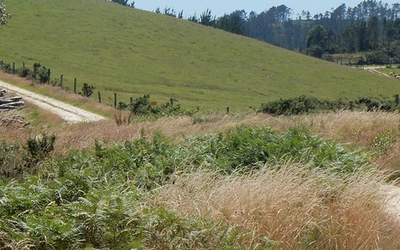
Section 5: Sarria to Santiago de Compostela (Stages 28–32, 117km) is the most heavily walked stretch of the Camino, through Galicia's rolling green hills, eucalyptus forests, and stone-walled lanes to the Praza do Obradoiro and the façade of the Cathedral of Santiago de Compostela.
Section 6: Santiago to Finisterre or Muxía (Stages 33–36, 91 or 87km) is the optional extension to the Atlantic. Most experienced pilgrims recommend walking to Finisterre first (past quiet forests and beautiful beaches) and then connecting to Muxía on the final coastal day. Both are dramatic ocean finishing points, and both are far quieter than the Santiago stages.
Where should I start the Camino Francés?
The Camino has no mandatory starting point — a compostela certificate is awarded to anyone who walks the final 100km or more (or cycles/rides the final 200km). The most popular starting options are:
Saint-Jean-Pied-de-Port is 'the whole Camino' — 784km in 4–5 weeks. Around 12% of all pilgrims begin here, including most non-Spanish walkers. Arrival involves travel to the French Basque Country; departure means the Pyrenean crossing on Day 1.
Pamplona or Roncesvalles removes the Pyrenees and is the starting point for around 4% of pilgrims. Pamplona (716km to Santiago) is well served by bus, train, and a small airport.
Burgos (497km, around 21 days) puts walkers straight into the Meseta. Just 1% of pilgrims begin here.
León or Astorga (314km or 260km) is the choice of around 6% of pilgrims, giving immediate access to some of the Camino's most beautiful mountain scenery. León has good rail, bus, and air links.
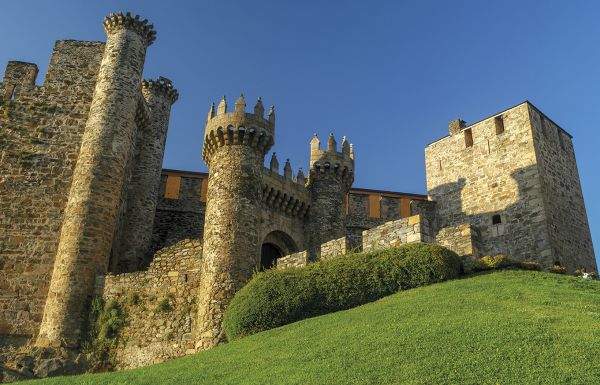
Ponferrada (208km, around 9 days) allows a relaxed day through the Bierzo vineyards before the O Cebreiro climb and is the fifth most common starting point.
O Cebreiro (156km, 6–7 days) is the fourth most popular start, reached mainly by private bus since public transport is limited to this mountaintop village.
Sarria (117km, 5 days) is the number one starting point across all caminos, busy in high season with school and youth groups walking the minimum for a compostela. It is a practical choice for those with a week available.
How long does the Camino Francés take?
Walking the full 784km from Saint-Jean to Santiago at 20–25km per day takes 32–39 days in theory. After accounting for rest days and the fact that accommodation is not always available at exact 20km intervals, most pilgrims should plan for 35–42 days. The ocean extension to Finisterre or Muxía adds 3–4 days.
The guidebook is based on a 32-stage itinerary from Saint-Jean to Santiago, organised across six sections each taking approximately one week. Stage planning tables in Appendix A lay out itineraries based on 20km and 30km daily averages and provide space for pilgrims to plan their own schedule.
When is the best time to walk the Camino Francés?
The Camino Francés is a four-season route, though each season has distinct characteristics.
- Spring (March to June) is the finest time for most pilgrims. The Meseta grain fields are a brilliant array of greens, temperatures are moderate, and the route is well populated but not overcrowded. Heavier spring rains keep the landscape lush but can make for wet walking days.
- Summer (July to August) is peak season. The hot Meseta sun can make the long flat stages demanding, and beds are scarce after Sarria; reservations are essential. After O Cebreiro the Camino fills with school-aged groups walking the last 100km.
- Autumn (September to October) is a strong alternative: fewer pilgrims, ripening vineyards and orchards, cooler temperatures, and the charm of walking through fallen leaves in the forest sections of Galicia. Rain becomes more frequent but is rarely a serious problem.
- Winter (November to February) is possible for experienced walkers but brings cold temperatures, potential snow on the Pyrenees and at O Cebreiro, reduced albergue availability, and shorter daylight hours. The lower Valcarlos route replaces the Route Napoléon in dangerous conditions.
- Holy Years (when 25 July falls on a Sunday — next in 2027, 2032, 2038, and 2049) bring significantly larger crowds throughout the year, higher bed prices, and a festive atmosphere in Santiago. Book well in advance.
Where do pilgrims stay on the Camino Francés?
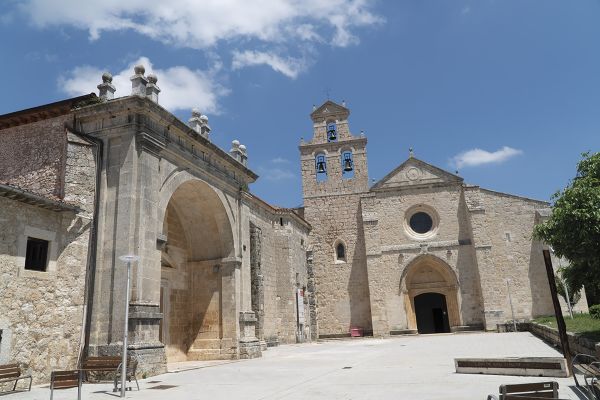
Accommodation on the Camino Francés ranges from spartan dormitories to comfortable hotels, covering virtually any budget. The guidebook lists over 500 pilgrim hostels across all stages.
Albergues (pilgrim hostels, pronounced 'al-bear-gaze') are the backbone of Camino accommodation. They come in several types: municipal albergues are cheapest (typically €15 or below) and run by local governments; parochial albergues are church-run and often ask for a donation; private albergues offer more services and usually accept reservations; Xunta albergues are Galicia-specific, government-run, and always have a kitchen but do not accept reservations; association albergues are run by pilgrim confraternities and are often particularly welcoming. All require a valid pilgrim credencial. Most allow one night only and have a mandatory morning departure time.
Hotels, hostals, and pensiónes offer private rooms at varying price points, from around €50/night for a double. These accept reservations and are the practical choice for those who prefer privacy or are affected by albergue snoring.
Casas rurales (rural houses) are sometimes rented by pilgrim groups or families seeking a shared kitchen and more space.
In high season, the cheapest albergues — municipal and parochial — do not accept reservations and require early afternoon arrival to secure a bed. In Holy Years and peak summer months, all accommodation should be booked in advance.
How much does the Camino Francés cost?
The Camino is one of the most affordable long-distance walking experiences in Europe. A minimum daily budget of around €25–35 covers a municipal or donativo albergue bed plus breakfast and a menú del peregrino (pilgrim menu) dinner of two or three courses including wine, typically priced at €8–15.
For those who prefer private rooms and more varied eating, costs rise quickly — a double hotel room averages around €50/night and non-pilgrim restaurant meals add €30 or more per day. Some pilgrims manage the entire walk for under €1000 (not including flights), cooking in albergue kitchens and staying in donation-based hostels.
Baggage transfer services, which carry packs between stages for around €4–6 per stage, are a popular option for those unable or unwilling to carry a full pack every day.
How do I get to and from the Camino Francés?
Getting to Saint-Jean-Pied-de-Port: The nearest airport is Biarritz (BIQ). Take the city bus (Ligne 14, halfhourly) from the airport to Bayonne's train station, then the spur rail line to Saint-Jean (approximately €14, 1 hour). Alternatively, trains from Paris Montparnasse or Paris CDG via Bordeaux connect to Bayonne. Pilgrims starting from Spanish cities can take a bus or train to Pamplona and then a bus to Saint-Jean.
Getting to other starting points: Pamplona is served by bus from Madrid and Barcelona, and by direct train from both cities. Burgos has train and bus connections. León has train, bus, and limited air links. Sarria is best reached by train from Madrid or Barcelona, or by bus from Santiago.
Leaving Santiago: The return from Santiago is straightforward. Trains run from Santiago's 1873 station to Madrid and other Spanish cities. The airport bus from Praza Galicia costs around €3 and runs every 30 minutes to Santiago Lavacolla airport (SCQ), which has direct flights to many European cities.
What are the highlights of the Camino Francés?
- The Pyrenees crossing (Stage 1) on the Route Napoléon is the most physically demanding single day of the Camino, climbing to nearly 1500m before the descent to Roncesvalles — and one of the most beautiful.
- Pamplona (Stage 3 end) is a proud Basque city of wide plazas, great tapas bars, and the famous July bull-running festival of San Fermín. Its cathedral and medieval old town are an early Camino highlight.
- The vineyards of La Rioja (Stages 7–8) produce some of Spain's finest wines and colour the route in jade and purple.
- Burgos Cathedral (Stage 12 end) is one of the finest Gothic cathedrals in Europe, its twin spires rising above a city that rewards a rest day.
- Cruz de Ferro (Stage 22–23) is the iron cross near the highest point of the Camino where pilgrims traditionally leave a stone from home as a symbolic release of burden. Many time their arrival for sunrise.
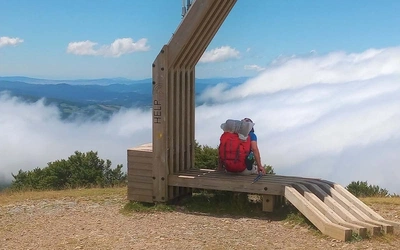
- O Cebreiro (Stage 26) is the dramatic mountain gateway into Galicia — a stone village of pallozas (Celtic round houses) at the top of the final great climb, where the character of the Camino changes completely.
- The Praza do Obradoiro in Santiago de Compostela (Stage 32 end) is the emotional endpoint of the journey: the baroque façade of the cathedral, the embrace of the Apostle James's statue inside, and the Pilgrim Mass at noon where the great botafumeiro censer swings above the congregation.
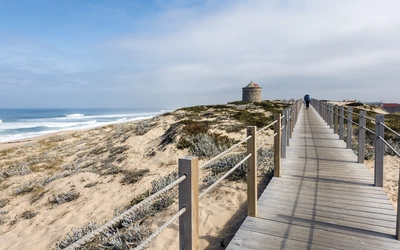
- Finisterre (Stage 35A) on the Costa da Morte was historically considered the end of the known world. Many pilgrims burn a piece of clothing or footwear here in a ritual of transformation and renewal before watching the sun set over the Atlantic.
How do I get my credencial and compostela?
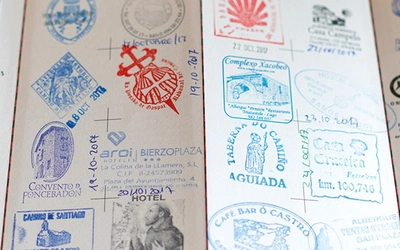
A credencial (pilgrim passport) is required to stay in most albergues and to receive a compostela at journey's end. It must be stamped (sello) at albergues, churches, and cafés along the way — at least twice per day for the final 100km from Sarria. Credenciales are available from your national confraternity before departure or for €3–5 at albergues or pilgrim information centres along the route. The major English-speaking confraternities are:
- Australia/New Zealand: Australian Friends of the Camino, afotc.org
- Canada: Canadian Company of Pilgrims, santiago.ca
- Ireland: The Camino Society of Ireland, caminosociety.com
- UK: Confraternity of St James, csj.org.uk
- USA: American Pilgrims on the Camino, americanpilgrims.org
The compostela certificate is issued free of charge at the Pilgrim Office in Santiago (Rúa Carretas 33, oficinadel peregrino.com/en) on presentation of a fully stamped credencial. A distance certificate costs €3 additional. Note that since 2024, e-bike riders are not eligible for a compostela.
Plan your walk with the Cicerone guidebook
The Cicerone Camino de Santiago: Camino Francés guidebook by Sandy Brown contains everything needed to plan and complete the full route from Saint-Jean-Pied-de-Port to Santiago and beyond.
- 36 customisable stages across six sections, from Saint-Jean to Santiago, with Finisterre and Muxía extensions
- Over 500 pilgrim hostels listed across all stages
- Route summary table covering all six sections by distance, overview, key places, and walking days
- Stage planning tables (Appendix A) with 20km and 30km daily average itineraries and space to plan your own
- Comprehensive planning sections covering where and when to begin, accommodation types, food, budgeting, transport, credencial and compostela, packing, training, health, and pilgrim etiquette
- Topographic overview of the Camino's five terrain zones and the Costa da Morte extension
- Climate tables for six points along the route from Saint-Jean to Finisterre
- Cultural and historical background on Navarre, Castile-León, and Galicia, including architecture, local festivals, and regional food and wine
- Free GPX files available to download via the Cicerone app
- Major local festivals (Appendix B), useful contacts and apps (Appendix C), and bibliography (Appendix D)
Available as a printed guidebook (£17.95) or digital eBook (£17.95).
Camino de Santiago: Camino Frances
Guide and map book - includes Finisterre finish
£17.95
Guidebook and map book to walking the 784km Camino Frances from St Jean-Pied-de-Port in southern France to Santiago de Compostela in Spain, including an additional route to Finisterre. Split into 6 sections and 36 customisable stages, the guide lists over 500 pilgrim hostels. The map book covers the entire route, which can be walked in 4-5 weeks.
More informationAbout Sandy Brown, guidebook author
Sanford 'Sandy' Brown is a community activist, long-distance walker, and ordained minister from Seattle, Washington. Inspired by Paulo Coelho's The Pilgrimage, he first walked the Camino de Santiago in 2008 and has since walked or biked over 20,000km on pilgrim trails in Spain, France, Switzerland, Italy, and the United States. He leads group pilgrimage treks through his travel company, pilgrimpaths.com. Sandy earned his undergraduate degree in medieval history at the University of Washington, his MDiv at Garrett Theological Seminary, and a doctorate from Princeton Theological Seminary in 1997. In 2023 the European Association of Via Francigena Ways bestowed its Honor Award on Sandy for his contributions to the development of the route. He lives with his wife, Theresa Elliott, in Lucca, Italy.