The Camino Inglés and Camino del Mar: a complete planning guide
Dave Whitson opens his Cicerone guidebook by noting that the rain in Spain falls mainly in Galicia, and it's precisely that lush, green corner of Iberia that makes planning a walk here worth doing properly. This guide covers everything you need to decide between the two routes: Whitson and Laura Perazzoli's guidebook maps out the 115km Camino Inglés from Ferrol (or a 73km alternative from A Coruña) and the wilder, 190km coastal Camino del Mar from Ribadeo, so you can work out which pilgrimage, or combination, suits you. (Last updated: September 2026 · Guidebook edition: Fourth edition, September 2026)
Quick facts
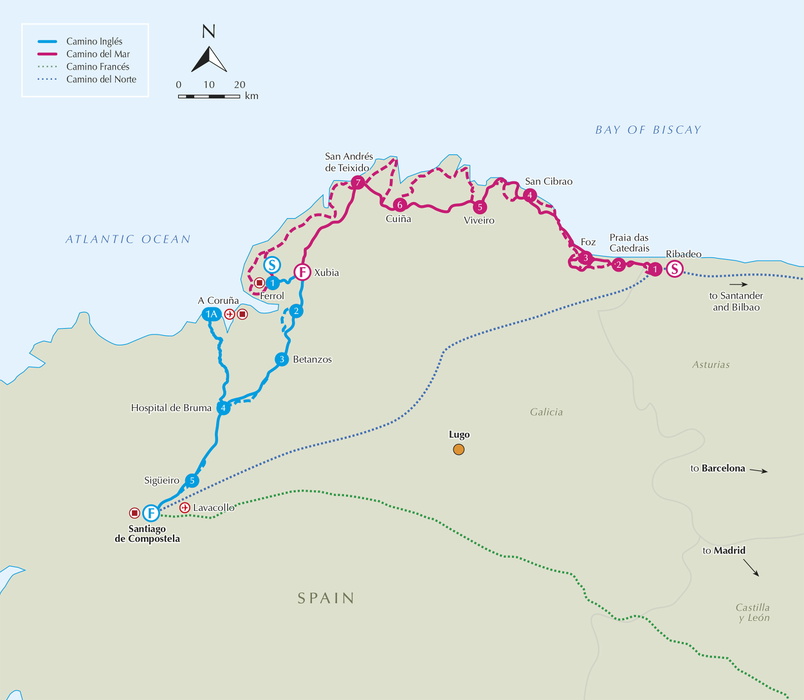
- Distance: Camino Inglés: 115km (71 miles) from Ferrol, or 73km (45 miles) on the alternative start from A Coruña. Camino del Mar: 190km (118 miles) from Ribadeo to Ferrol
- Typical duration: Camino Inglés: 4 to 7 days (around a week). Camino del Mar: around a further week as an extension
- Start: Camino Inglés: Ferrol or A Coruña. Camino del Mar: Ribadeo
- Finish: Camino Inglés: Santiago de Compostela. Camino del Mar: Ferrol/Xubia, joining the Camino Inglés
- Stages: Camino Inglés: 5 stages (plus an alternative start stage from A Coruña). Camino del Mar: 7 stages
- Difficulty: Camino Inglés is moderate and accessible to novice walkers; the Camino del Mar is more challenging, with less reliable waymarking
- Terrain: Coastal paths, countryside tracks, small towns, harbours and woodland sections
- Waymark: Yellow arrows (flechas amarillas) and concrete pilgrim markers on the Camino Inglés; waymarking on the Camino del Mar is improving but still inconsistent in places
- Accommodation: Pilgrim albergues, hostales, pensións and hotels on the Camino Inglés; albergues are scarce on the Camino del Mar, so walkers rely more on hotels and guesthouses
- Best season: Spring to early autumn, with summer the busiest and driest
- GPX files: Available to download for both routes
- Guidebook:The Camino Inglés and Camino del Mar, Dave Whitson and Laura Perazzoli, 4th edition (September 2026)
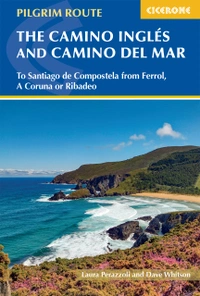
The Camino Ingles and Camino del Mar
To Santiago de Compostela from Ferrol, A Coruna or Ribadeo
£17.95
Guidebook to walking the Camino Inglés and Camino del Mar pilgrim routes in northwest Spain. Describes the 115km Camino Inglés from Ferrol or A Coruña to Santiago de Compostela and the of the 190km Camino del Mar linking Ribadeo with the Inglés at Ferrol.
More informationWhat is the Camino Inglés and Camino del Mar?
The Camino Inglés is a pilgrimage route to Santiago de Compostela that begins on Galicia's northern coast, at Ferrol or A Coruña, and takes its name from the medieval pilgrims who sailed from the British Isles to reach it. Whitson and Perazzoli's guidebook explains that its appeal lies in offering much of the character of the more famous Camino Francés (reliable waymarking, a well-established chain of pilgrim albergues, and the chance to earn the Compostela certificate in Santiago) without the volume of foot traffic that the Francés now attracts. It's a genuinely useful "starter camino" for walkers with limited time, gentle enough underfoot for most fitness levels while still delivering long pilgrim days.
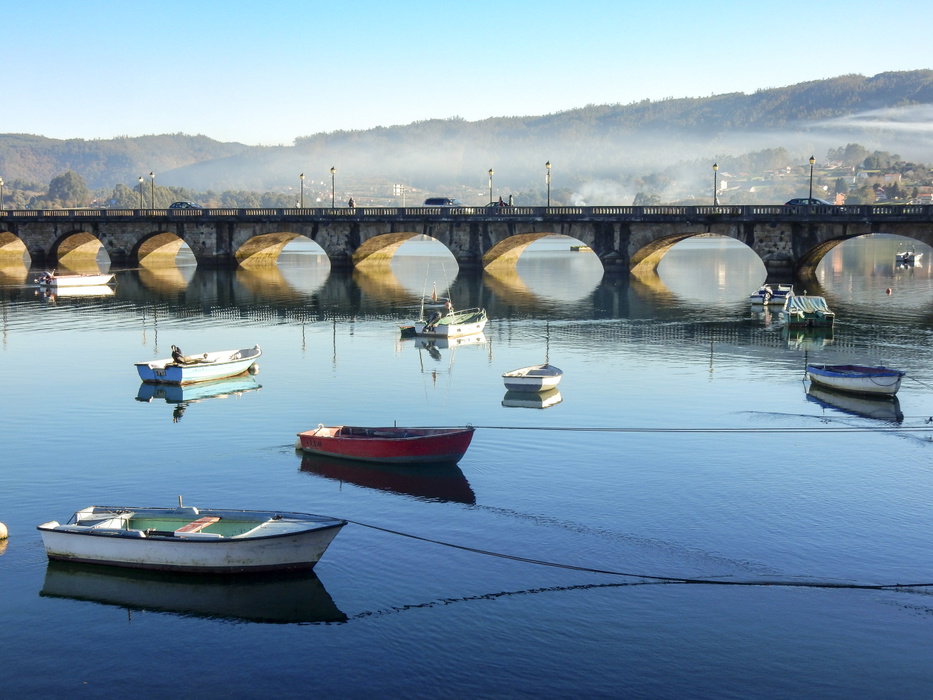
The Camino del Mar is a more recent addition to the network, reconstructed by historians over the past two decades from medieval pilgrim roads linking Ribadeo to Ferrol along Galicia's Atlantic coast. It's still early in its redevelopment, with no single fixed route yet, so "Camino del Mar" covers several coastal trail variants converging on the same waypoints: San Martiño de Mondoñedo, among the oldest cathedrals in Spain, the historic port of Viveiro, and the pilgrimage shrine of San Andrés de Teixido, before joining the Camino Inglés. Only 179 pilgrims completed it in 2025, against 28,899 on the Camino Inglés, making it one of the least-walked and most solitary approaches to Santiago currently open to pilgrims.
Both routes run through Galicia, a region shaped by Celtic hill forts, Roman mineral roads and, above all, the discovery of Saint James's remains in the ninth century, which transformed Santiago de Compostela into one of Christendom's three great pilgrimage centres alongside Jerusalem and Rome. This planning guide answers the most common questions walkers have before setting out on either route. For complete stage-by-stage route descriptions and mapping, see the Cicerone Camino Inglés and Camino del Mar guidebook.
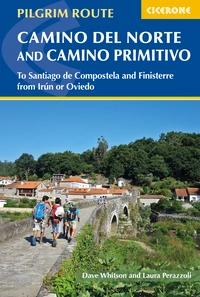
Walkers extending their pilgrimage north or south along the coast may also want to look at Cicerone's guide to the Camino del Norte and Camino Primitivo, which connects with the Camino del Mar at Ribadeo.
How long is the Camino Inglés?
The Camino Inglés covers 115km (71 miles) from Ferrol to Santiago de Compostela across 5 stages, or 73km (45 miles) in 4 days on the alternative start from A Coruña.
| Stage | Distance | Time | Ascent / Descent |
|---|---|---|---|
| 1: Ferrol to Pontedeume | 29.5km (18.3 miles) | 7hr 10min | 615m / 615m |
| 2: Pontedeume to Betanzos | 20.2km (12.6 miles) | 5hr 45min | 705m / 685m |
| 3: Betanzos to Hospital de Bruma | 24.8km (15.4 miles) | 6hr 25min | 820m / 455m |
| 4: Hospital de Bruma to Sigüeiro | 24.6km (15.3 miles) | 5hr 30min | 320m / 485m |
| 5: Sigüeiro to Santiago de Compostela | 15.7km (9.8 miles) | 3hr 50min | 310m / 285m |
| 1A (alternative start): A Coruña to Hospital de Bruma | 32.2km (20.0 miles) | 8hr 20min | 935m / 560m |
The toughest day on the Camino Inglés is Stage 1, from Ferrol to Pontedeume, which is both the longest stage and the longest day in the saddle for most walkers at over 7 hours. Those starting from A Coruña face a demanding first day too, with 935m of ascent on the alternative start stage into Hospital de Bruma.
How long is the Camino del Mar?
The Camino del Mar runs 186.3km (115.8 miles) from Ribadeo to Ferrol, where it joins the Camino Inglés, across 7 stages.
| Stage | Distance | Time | Ascent / Descent |
|---|---|---|---|
| 1: Ribadeo to Praia das Catedrais | 17.8km (11.1 miles) | 4hr 5min | 340m / 370m |
| 2: Praia das Catedrais to Foz | 21.9km (13.6 miles) | 5hr 15min | 480m / 495m |
| 3: Foz to San Cibrao | 31.8km (19.8 miles) | 7hr 40min | 715m / 715m |
| 4: San Cibrao to Viveiro | 31.7km (19.7 miles) | 8hr 50min | 1030m / 1035m |
| 5: Viveiro to Cuiña | 29.7km (18.5 miles) | 9hr | 1090m / 1085m |
| 6: Cuiña to Teixido | 19.8km (12.3 miles) | 5hr 30min | 715m / 590m |
| 7: Teixido to Xubia | 33.6km (20.9 miles) | 9hr 20min | 925m / 1070m |
The most demanding stage is Viveiro to Cuiña, with 1090m of ascent over nearly 30km and no let-up in terrain; Foz to San Cibrao and Teixido to Xubia are the longest days by distance, both over 31km.
Who is the Camino Inglés and Camino del Mar suitable for?
The Camino Inglés suits almost any walker with a reasonable level of fitness, including those new to long-distance pilgrimage. The terrain is manageable throughout, even if it is rarely flat, and the network of pilgrim albergues and shorter stage options make it a forgiving route for a first camino.
The Camino del Mar is better suited to experienced long-distance walkers. The guidebook is direct about this: less reliable waymarking, a scarcity of pilgrim hostels, and a few stages where limited accommodation pushes walkers toward longer days of around 30km mean it rewards confidence with navigation and self-sufficiency. Walkers who want solitude and don't mind carrying a GPS device or app will get the most out of it.
How difficult is it?
The Camino Inglés is rated moderate and is described in the guidebook as highly accessible even to novice walkers, with reliable waymarking and consistent accommodation. The Camino del Mar is rated more challenging, both for its terrain (several stages exceed 1000m of cumulative ascent) and for its inconsistent waymarking; the guidebook recommends carrying GPX tracks rather than relying on the yellow arrows alone. Both routes use a five-tier difficulty scale from easy to strenuous for individual stages, and neither route's overall length is factored into that stage-by-stage rating, so plan pack weight and pacing with total daily hours in mind as well.
Can I walk a shorter section?
Yes. The most common way to shorten the Camino Inglés is to start in A Coruña rather than Ferrol, cutting the walk to 72.5km (45.1 miles) over 4 days while still qualifying for the Compostela. This was historically the busier medieval starting point, so it comes with its own pilgrim heritage rather than feeling like a compromise.
On the Camino del Mar, the guidebook builds in flexibility: walkers can follow the more direct Camino del Mar track or the coastal Camiño Cantábrico alternative stage by stage, and can join or leave the route at several points along the way, including linking directly into the Camino Inglés at Ortigueira rather than continuing the full distance to Xubia.
Should I walk the Camino Inglés or the Camino del Mar?
For a first pilgrimage, or for walkers with a week to spare and a preference for dependable infrastructure, the Camino Inglés is the more straightforward choice: it is fully developed, with waymarking, albergues and pilgrim traffic all well established. The Camino del Mar is pitched at walkers who already have long-distance experience and want to be part of a route still finding its final shape, with dramatic coastal scenery to match the extra logistical effort.
The two routes aren't mutually exclusive. Walkers with more time can combine them, starting on the Camino del Mar at Ribadeo and continuing onto the Camino Inglés at Ferrol, for a journey of around 300km. Pilgrims already walking the Camino del Norte can use this same link to reach Santiago via the coast almost entirely, avoiding the Camino Francés altogether, though this adds roughly 100km compared with the standard Norte/Francés combination.
How do I earn the Compostela pilgrim certificate?
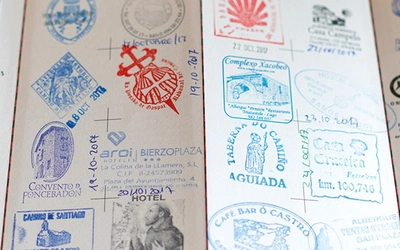
To receive the Compostela in Santiago, walkers need a credencial (pilgrim passport), available from tourist offices in Ferrol and Ribadeo, the pilgrim office in Santiago, or organisations such as the Confraternity of Saint James in the UK. Each day, pilgrims collect a sello (stamp), usually from an albergue, though bars, churches and town halls can also provide one; stamps can be harder to find on the Camino del Mar. To qualify for the Compostela, walkers must complete a minimum of 100km on foot, with at least 70km in Spain, and collect two stamps per day over the final 100km into Santiago.
When is the best time to walk the Camino Inglés and Camino del Mar?
- Summer (June–August): The most reliable weather and the busiest season on both routes, with the highest demand for albergue beds on the Camino Inglés and higher hotel prices in the seasonal coastal towns of the Camino del Mar
- Spring and early autumn: A good balance of settled weather and lighter pilgrim traffic on the Camino Inglés
- March and October: The guidebook singles these months out for walkers seeking solitude on the Camino Inglés, and notes that the Camino del Mar is quiet almost year-round
- Winter: Both routes are walkable, but expect wet, windy conditions and reduced services; some coastal towns on the Camino del Mar close down outside the summer season
Getting there and back
To Ferrol or A Coruña: Vueling, Iberia, Air Europa and other airlines fly into A Coruña airport, connected to the city centre by the Alsa 4051/A4 bus. From A Coruña, RENFE trains run to Santiago de Compostela (30–40 minutes) and to Ferrol (around 1hr 15min, five services daily), and MonBus operates hourly buses on the same routes.
From Santiago de Compostela: Lavacolla airport, just outside the city, connects with easyJet, Iberia and Vueling, among others. RyanAir had announced it would stop serving Lavacolla after March 2026, so check current routes before booking. RENFE runs six trains daily to Madrid (5–6 hours), plus a daily service to Hendaye at the start of the Camino del Norte, and ALSA covers long-distance bus connections.
What are the route highlights?
- Santiago de Compostela's cathedral, the pilgrimage's endpoint and one of Christendom's three great historic pilgrimage centres
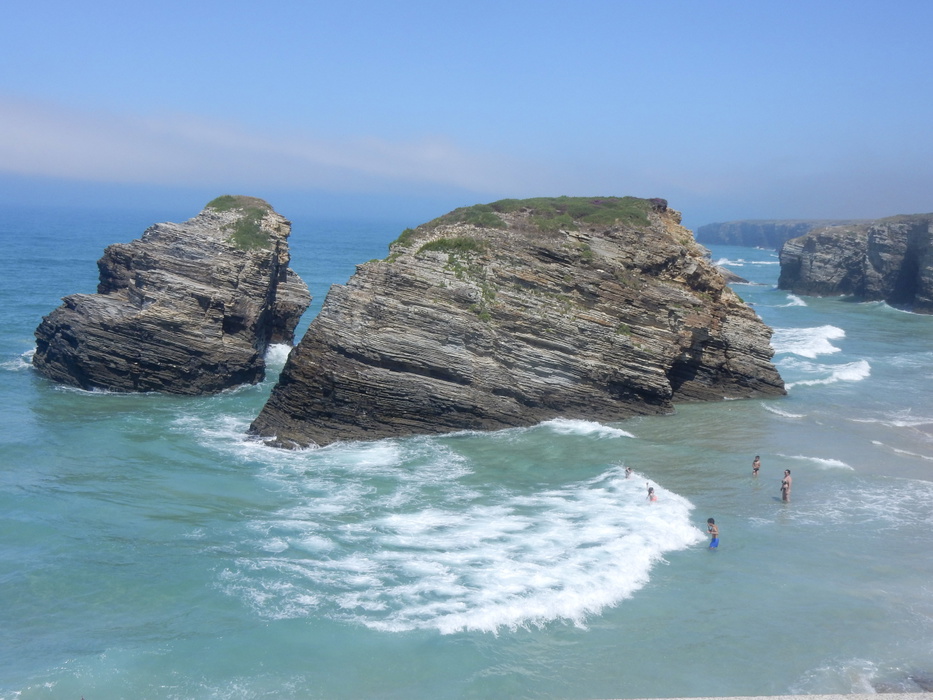
- Praia das Catedrais, the dramatically eroded "Cathedrals Beach" on the Camino del Mar
- Vixía Herbeira, among continental Europe's highest coastal cliffs, on the Camino del Mar
- San Andrés de Teixido, a major pilgrimage shrine integrated into the Camino del Mar
- San Martiño de Mondoñedo, likely the oldest cathedral in Spain
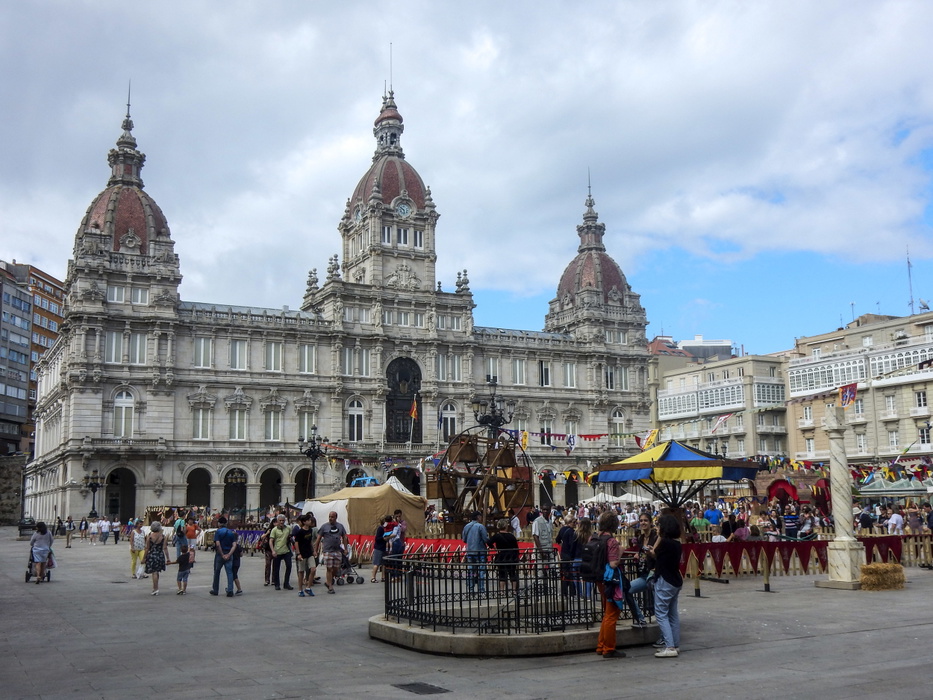
- Ferrol and A Coruña, historic Galician harbour towns and the Camino Inglés's two starting points
The Camino Ingles and Camino del Mar
To Santiago de Compostela from Ferrol, A Coruna or Ribadeo
£17.95
Guidebook to walking the Camino Inglés and Camino del Mar pilgrim routes in northwest Spain. Describes the 115km Camino Inglés from Ferrol or A Coruña to Santiago de Compostela and the of the 190km Camino del Mar linking Ribadeo with the Inglés at Ferrol.
More informationPlan your Camino Inglés and Camino del Mar walk with the Cicerone guidebook
The Camino Inglés and Camino del Mar by Dave Whitson and Laura Perazzoli contains everything you need to plan and complete either route, from Ferrol, A Coruña or Ribadeo to Santiago de Compostela.
- Detailed stage-by-stage descriptions for the 114.8km Camino Inglés from Ferrol, plus the 72.5km alternative start from A Coruña
- Full coverage of the 186.3km Camino del Mar from Ribadeo, including both the direct route and the coastal Camiño Cantábrico alternative
- Clear 1:100,000 route maps for every stage, plus larger-scale town maps
- Downloadable GPX files for both routes
- Practical guidance on pilgrim passports, the Compostela and albergue etiquette
- Accommodation listings covering albergues, hotels and guesthouses along both routes
- Appendices covering useful contacts and transport, accommodation tables, an English-Spanish-Gallego glossary and further reading
Available as a printed guidebook (£17.95) or digital eBook. The guide is also accessible through the Cicerone app for GPS-enabled navigation on the trail.
About Dave Whitson and Laura Perazzoli, guidebook authors
Dave Whitson is a high school History teacher in Portland, Oregon and a graduate of the University of Washington. He made his first pilgrimage in 2002 on the Camino Francés and was inspired to return with a group of his high school students, which he did in 2004. He has led a total of seven student pilgrimage trips, including five on the Camino de Santiago (four on the Francés and one on the Norte) and two on the Via Francigena. In addition, he has made long distance treks in Norway on the Pilgrim Road to Nidaros, in England on the North Downs Way to Canterbury, and in Turkey on the Lycian Way. All told, he has walked roughly 10,000 kilometers on pilgrim roads in Europe.
Laura Perazzoli graduated from John Hopkins University with a degree in Writing Seminars and currently lives in Seattle, Washington. She completed her first pilgrimage in 2004 on the Camino Francés as one of the students on Dave Whitson's initial student pilgrimage. After this trip, she was excited to provide others with a similar experience and has since led student pilgrimage trips on the Camino Francés, the Camino del Norte and the Via Francigena. Laura first walked the Camino del Norte and Primitivo with a student group in 2009 and returned in 2011 to re-walk the route and to complete the Camino Inglés to ensure up-to-date route information for this guidebook.