


Mountain Walking in Mallorca
50 routes in Mallorca's Tramuntana


Mountain Walking in Mallorca
50 routes in Mallorca's Tramuntana
Guidebook describing 50 full and half-day walks in Mallorca's mountainous northwest. Ranging from 5.5km to 24km, the routes showcase the outstanding natural beauty and mountain heritage of the Serra de Tramuntana. Potential bases include Pollença, Sóller, Valldemossa and Andratx, and most walks are accessible by public transport.Most visitors to Mallorca never venture beyond the coast, yet rising immediately behind the shoreline lies the Serra de Tramuntana, a UNESCO World Heritage mountain range of rugged limestone peaks, ancient terraced hillsides, hidden gorges and centuries-old stone paths that rival any mountain walking destination in the Mediterranean.
This comprehensive guidebook by expert author Paddy Dillon presents 50 walks across the Tramuntana, ranging from 4 to 24km (2 to 15 miles) and taking between 2 and 8 hours. Many routes involve steep ground, hands-on scrambling and navigational challenge, and are primarily geared towards those comfortable with mountain conditions.
- 50 walks are included, divided across seven areas, spanning the full length of the Serra de Tramuntana from Andratx in the southwest to Formentor and Alcúdia in the northeast, with bases including Valldemossa, Sóller, Deià and Pollença
- Highlights of the walk include the Torrent de Pareis gorge, one of the most dramatic canyon walks in the Balearic Islands, the island of Sa Dragonera, the Camí de s'Arxiduc ridge and the summit of Puig de Massanella, the highest accessible peak in Mallorca
- Mallorca's ancient mountain heritage is experienced throughout, with routes following centuries-old drovers' paths, dry stone terraces and historic mountain tracks that formed the basis for the Serra de Tramuntana's UNESCO World Heritage designation
- 1:25,000 Editorial Alpina mapping and downloadable GPX files for every walk, with detailed public transport information making most routes accessible from Palma and the island's main towns without a hire car
- Practical mountain guidance on weather, path conditions, kit requirements and safety, alongside notes on wildlife, wildflowers, history and food and drink throughout
Mallorca mountain walking is unlike anything the island's coastal reputation suggests. This guidebook is the essential companion for exploring the Serra de Tramuntana on foot, and the best reason to see a very different side of one of Europe's most visited islands.
Mountain Walking in Mallorca - Quick Facts
Area: Serra de Tramuntana, northwest Mallorca, Balearic Islands, Spain
Designation: Serra de Tramuntana UNESCO World Heritage Site
Total walks: 50
Walk distances: 4 to 24km (2 to 15 miles)
Walk duration: 2 to 8 hours
Difficulty: Primarily for walkers with mountain experience; many routes involve steep ground, hands-on scrambling and navigational challenge; ropes useful in places such as the Torrent de Pareis
Areas covered: Sant Elm and Andratx, Banyalbufar and Valldemossa, Sóller and Deià, Bunyola and Alaró, Cúber and Tossals Verds, Lluc and Escorca, Pollença and Formentor
Highlighted walks: Torrent de Pareis gorge, sa Dragonera island, Puig de Massanella, Camí de s'Arxiduc, Formentor, Puig de Galatzó, Serra d'Alfàbia
Highest accessible peak: Puig de Massanella
Centres: Andratx, Valldemossa, Deià, Sóller, Pollença, Port de Pollença, Lluc, Alaró
Access: Most walks are accessible by public transport from Palma; detailed bus information is included
Mapping: 1:25,000 Editorial Alpina maps included for every walk
Digital navigation: Downloadable GPX files included
Best time to visit: Spring for colour and cooler temperatures; autumn generally fine; winter possible but wetter with possible snow on the highest peaks; summer too hot for most walking
Special features: Notes on mountain heritage, wildlife, wildflowers, history, food and drink; mountain safety and kit guidance
Author Highlight
“Mallorca is the largest of the Balearic Islands, basking in sunny splendour in the Mediterranean between Spain and Algeria. It has been a favourite destination for sun-starved northern Europeans for many decades. While beach holidays remain popular, more and more visitors seek the quieter pleasures of rural Mallorca, especially taking opportunities to explore the island’s most rugged mountain range, the Serra de Tramuntana.”
- Paddy Dillon, author of Mountain Walking in Mallorca
Printed book
A guidebook with detailed route descriptions, stage breakdowns, accommodation listings, profiles and maps - everything you need on the trail.
ISBN
9781852849498
Availability
Published
Reprinted
10 Jun 2025
Published
10 May 2018
Edition
First
Pages
288
Size
17.20 x 11.60 x 1.60cm
Weight
330g
eBook
The complete digital edition of the guidebook, with full route descriptions, accommodation listings, profiles and maps, ready to use on any device. To access your eBook, you will need an eReader app. For more details, visit the eBook FAQs.
Overview map
Map key
Route summary table
Introduction
Serra de Tramuntana
Brief history of Mallorca
Mountain heritage
Wildlife
Travel to Mallorca
Travel around Mallorca
When to go
Mountain weather
Accommodation
Language
Money
Food and drink
Kit check
Mountain maps
Path conditions
Guided walking
Emergencies
Using this guide
Sant Elm, es Capdellà, Calvià, Galilea and Puigpunyent
Walk 1 sa Dragonera
Walk 2 Port d’Andratx and Pintal Vermell
Walk 3 Sant Elm, La Trapa and s’Arracó
Walk 4 Mola de s’Esclop from Ses Fontanelles
Walk 5 Mola de s’Esclop from es Capdellà
Walk 6 Mola de s’Esclop from Boal de ses Serveres
Walk 7 Puig de Galatzó from Boal de ses Serveres
Walk 8 Puig de Galatzó from Font des Pi
Walk 9 Puig de Galatzó from es Capdellà
Walk 10 Calvià to Galilea and Puigpunyent
Walk 11 Camí Vell d’Estellencs and Camí de Superna
Banyalbufar, Esporles, Valldemossa and Deià
Walk 12 Banyalbufar and Mola de Planícia
Walk 13 Banyalbufar, Port des Canonge and Esporles
Walk 14 Esporles to Valldemossa
Walk 15 Valldemossa and Talaia Vella
Walk 16 Valldemossa, Puig des Teix and Camí de s’Arxiduc
Walk 17 Valldemossa to Deià
Walk 18 Deià coastal walk
Sóller, Port de Sóller, Fornalutx and Biniaraix
Walk 19 Camí des Rost and Camí de Castelló
Walk 20 Sóller, Fornalutx and Mirador de ses Barques
Walk 21 Mirador de ses Barques to Cala Tuent
Walk 22 Port de Sóller and Puig de Bàlitx
Walk 23 Serra d’Alfàbia and Cornador Gran
Walk 24 Fornalutx, Monnàber and Portell de sa Costa
Walk 25 Penyal des Migdia
Bunyola, Orient, Alaró and Santa Maria
Walk 26 Puig de s’Alqueria from Bunyola
Walk 27 Bunyola and Penyal d’Honor
Walk 28 Vall de Coanegra and Santa Maria
Walk 29 Alaró, Orient and Puig d’Alaró
Walk 30 Serra d’Alfàbia from Orient
Cúber and Tossals Verds
Walk 31 sa Rateta, na Franquesa and Puig de l’Ofre
Walk 32 Cúber, Pas Llis and Tossals Verds
Walk 33 Puig des Tossals Verds and Morro d’Almallutx
Walk 34 Cúber, Tossals Verds, Solleric and Alaró
Walk 35 Cúber, Puig de Massanella and Lluc
Santuari de Lluc, Escorca and Caimari
Walk 36 Torrent de Pareis
Walk 37 Puig de Massanella from Coll de sa Batalla
Walk 38 Puig d’en Galileu from Lluc
Walk 39 Caimari and Puig de n’Ali
Walk 40 Caimari, Camí Vell and ses Figueroles
Walk 41 Puig Tomir from Lluc
Walk 42 Mossa, Puig Roig and Lluc
Walk 43 Lluc, Binifaldó and Menut
Pollença, Formentor and Alcúdia
Walk 44 Lluc to Pollença
Walk 45 Mortitx and Rafal d’Ariant
Walk 46 Pollença and Puig de Maria
Walk 47 Serra del Cavall Bernat
Walk 48 Formentor and na Blanca
Walk 49 el Fumat and Cala Murta
Walk 50 Penya des Migdia and Talaia d’Alcúdia
Appendix A Glossary
Appendix B Public transport
Appendix C Useful contacts
Seasons
The best and most colourful season is spring, before the summer heat makes walking difficult. Autumn is usually fine, while winter is possible, but wetter, with snowfall possible on the highest mountains.
Centres
Port d'Andratx, Sant Elm, es Capdellà, Calvià, Puigpunyent, Estellencs, Banyalbufar, Esporles, Valldemossa, Deià, Sóller, Bunyola, Alaró, Caimari, Lluc, Pollença, Port de Pollença, Alcúdia
Difficulty
The mountains of Mallorca feature some very rough and rocky terrain, and at times it is necessary to walk slowly and carefully, and be prepared to use hands to scramble. Ropes are useful in places such as the Torrent de Pareis, but care is needed on all walks.
Must See
Outstanding limestone scenery and coastal vistas, the island of sa Dragonera, Torrent de Pareis gorge, lofty peaks, ancient paths, drystone heritage, wildflowers and birdwatching
April 2025
Signposts and waymarks
Walk 2 - Port d'Andratx and Pintal Vermell
Walk 3 - Sant Elm, La Trapa and s'Arracó
Walk 2 and the first part of Walk 3, from Sant Elm to La Trapa, were always intended to be part of the GR221 trail, but they hadn't been signposted or waymarked when the book was reprinted in 2025. However, during the printing process, signposts and waymarks were installed on both of these walks. Just in case there are any slight discrepancies between the route description and the waymarked route, please follow the route indicated by the signposts and waymarks.
May 2023
Walk 26
The recent strengthening of locked gates on the descent makes it difficult to complete this route as a circuit. The best thing is to treat it as a there-and-back ascent and descent of Puig de s'Alqueria. This has no effect on the route statistics as the distance, ascent/descent and time for completion remain the same.
April 2023
Storm Juliette - closed routes
The mountains of Mallorca were severely affected by Storm Juliette early in 2023, which dumped over 3 metres of snow in some places. The weight of snow uprooted some trees and broke the branches off many more trees, causing the complete closure of some walking routes. The island council sent over 100 workers into the mountains to clear the 'official' signposted and waymarked trails, and many volunteers also assisted. However, paths on some private estates remain closed, and while a few of these might be cleared by volunteers in the future, it is likely that some will remain permanently closed. The following routes in the book are still closed at some point, generally in wooded areas above 400m. Please avoid them unless you hear that they have been reopened.
Walk 12 The higher parts of Mola de Planícia
Walk 23 The ascent from Sóller to Serra d'Alfàbia
Walk 24 Through the Bosc de Monnàber and the descent from Portell de sa Costa
Walk 30 The ascent from Orient to Serra d'Alfàbia
Walk 38 The ascent from Coll de sa Batalla through Pas de sa Rebollada
Walk 39 The ascent of Puig de n'Ali
Walk 40 Paths between Coll de sa Batalla and Binibona are very badly affected
Walk 41 Paths between Alcanella and Coll des Pedregaret are very badly affected
Walk 43 Path at es Pixarells is very badly affected
April 2022
Walk 21
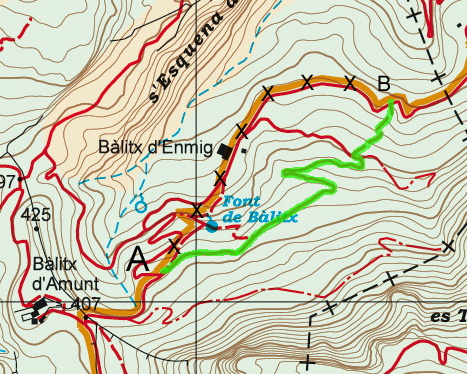
The country house of Bàlitx d'Enmig is under new ownership. Abundant notices point out that walkers should no longer pass the house. A new signposted and waymarked route offers a diversion. Before reaching Font de Bàlitx, the route now runs through olive groves above Bàlitx d'Enmig, offering better views than previously, and soon descends to rejoin the original route. See the map extract and follow the new route indicated in green between A and B. Do not follow the former route.
March 2022
Walk 22 - Port de Sóller and Puig de Bàlitx
Following a change in ownership in 2021, access to Puig de Bàlitx has been closed. The paths described on the circuit have been fenced off and a gate now bars entry to the cave of Cova des Migdia. While local walkers have already cut holes in the fences, it is best for visiting walkers to avoid this walk.
Free Royal Mail 48 postage on UK orders. European postage is £3.50 per item. Worldwide postage is £5.50 per item. If you're not happy with your purchase for any reason, we'll give you a full refund.
Learn moreDiscover the Cicerone App
The Cicerone App brings decades of expertise straight to your phone, making it easier than ever to plan and enjoy your adventures wherever you are. For use with In-App guides — not compatible with eBooks.


Popular related guides


