

 New
New
Hillwalking in Shropshire
32 hill and country walks


Hillwalking in Shropshire
32 hill and country walks
Guidebook to 32 walking routes in Shropshire in the West Midlands. The routes range from 3 miles (5km) to 12 miles (19km), taking in highlights such as The Wrekin, Wenlock Edge, Long Mynd and Stiperstones, Castle Ring and Bury Ditches. Many routes start near delightful towns and villages including Church Stretton, Ludlow and Bishops Castle.Explore the scenic hills and countryside of Shropshire, where volcanic ridges, heathery summits, wooded valleys and historic sites create some of England’s most varied walking landscapes. Lying mostly within the Shropshire Hills National Landscape, these routes combine rugged upland scenery with pastoral farmland and ancient woodlands, offering rewarding hill and country walks for walkers of all experience levels.
Written by experienced author John Gillham, this guidebook is the perfect companion for exploring the Shropshire Hills on foot, with 32 carefully chosen day walks that reveal the county’s dramatic topography and rich natural heritage. The routes range from easy countryside strolls to more challenging upland excursions, showcasing highlights such as The Wrekin, Long Mynd, Stiperstones and historic hillforts alongside rivers, woods and rolling hillsides.
- The guidebook describes 32 hill and country walks across Shropshire, allowing you to explore the distinctive landscapes of the Shropshire Hills National Landscape and surrounding countryside, from volcanic ridges and rocky outcrops to wooded valleys and riverside paths
- Walks range from 5–22 km (3–14 miles), offering everything from gentle lowland routes to longer hill climbs across upland terrain, so there’s something suitable for walkers of many fitness and experience levels
- Each route is supported by clear step-by-step descriptions and detailed 1:50,000 OS mapping (reproduced at 1:40,000 for clarity), helping you navigate the hills, ridges and valleys of Shropshire with confidence
- Downloadable GPX files make digital navigation simple, so you can follow routes on your GPS device or smartphone while discovering the high ridges of the Long Mynd or the craggy summit tors of Stiperstones
- Practical travel and planning information covers accommodation listings, public transport details and refreshment stops in key towns and villages, including Church Stretton, Ludlow and Bishops Castle
With its carefully selected routes, clear mapping and local insight, this guidebook provides everything you need to explore Shropshire’s hills and hidden valleys on foot. Follow winding ridge tops, discover ancient hillforts and enjoy panoramic views across one of England’s most picturesque walking destinations, easily accessible from towns and cities including Shrewsbury, Birmingham and Manchester.
Hillwalking in Shropshire - Quick Facts
Guidebook name: Hillwalking in Shropshire
Location: Shropshire Hills National Landscape, Shropshire, England, UK
Routes included: 32 day walks
Distance range: ~5–22 km / 3–14 miles per walk
Typical duration: Half-day to full-day walks
Key towns and villages: Church Stretton, Ludlow, Bishops Castle, Shrewsbury, Bridgnorth, Welshpool
Navigation: Step-by-step route descriptions with 1:50,000 OS mapping (reproduced at 1:40,000) and downloadable GPX files
Terrain: Upland ridges, heathery summits, wooded valleys, riverside paths, volcanic ridges, and historic hillforts
Difficulty: Easy to moderate, with some longer hill climbs suitable for experienced walkers
Best season: Spring to autumn (Mar–Oct), though many routes are accessible year-round in good conditions
Highlights: The Wrekin summit, panoramic views from Long Mynd and Stiperstones, ancient hillforts like Bury Ditches, historic market towns and riverside trails
Author Highlight
“Shropshire lies at the heart of England but well away from the cities, the smoke and the noise. It is an extremely rural county with only two sizeable towns – Shrewsbury and Telford. Stand on any of its mountains and you’ll see a patchwork of greenery; pastures divided by hedgerow and woodland copses. It’s undulating country, never truly mountainous but with sufficient distinctive peaks and rocks to keep a walker happy for years.”
- John Gillham, author of Hillwalking in Shropshire
Printed book
A guidebook with detailed route descriptions, stage breakdowns, accommodation listings, profiles and maps - everything you need on the trail.
ISBN
9781852848071
Availability
Published
Reprinted
31 Jan 2022
Published
16 Sept 2016
Edition
First
Pages
192
Size
17.20 x 11.60 x 1.35cm
Weight
220g
eBook
The complete digital edition of the guidebook, with full route descriptions, accommodation listings, profiles and maps, ready to use on any device. To access your eBook, you will need an eReader app. For more details, visit the eBook FAQs.
Map key
Overview map
Introduction
Shropshire geology (by Ronald Turnbull)
History
Plants and wildlife
Getting there
Getting around
When to go
Bases for the Shropshire hills
Maps and GPS
Safety
Using this guide
The walks
Walk 1 Llanfair Hill and Offa’s Dyke
Walk 2 Knighton, Cwm-sanaham Hill and Offa’s Dyke
Walk 3 Mary Knoll and Ludlow
Walk 4 Titterstone Clee Hill
Walk 5 The Bury Ditches
Walk 6 Burrow Fort and Hopesay Hill
Walk 7 Norton Camp and Stokesay Castle
Walk 8 Callow Hill and Flounders Folly
Walk 9 Brown Clee Hill and Stanbroughs Wood
Walk 10 Brown Clee Hill and Clee Liberty
Walk 11 High Rock, Bridgnorth and the River Severn
Walk 12 Bromlow Callow and Mitchell’s Fold
Walk 13 Nipstone Rock
Walk 14 Stiperstones
Walk 15 Snailbeach and the Castle Ring fort
Walk 16 Norbury Hill from Wentnor
Walk 17 Minton Hill and the Packet Stone
Walk 18 Adstone Hill
Walk 19 Pole Bank and Devil’s Mouth
Walk 20 The Long Mynd and Ragleth Hill
Walk 21 Caer Caradoc
Walk 22 The Long Mynd skyline
Walk 23 Plush Hill, the Batch and Castle Hill
Walk 24 Ridges Three, Hope Bowdler Hill,
Caer Caradoc and the Lawley
Walk 25 The Lawley
Walk 26 Hope Bowdler Hill from Cardington
Walk 27 The Betchcott Hills and Duckley Nap
Walk 28 Much Wenlock and the Wenlock Edge
Walk 29 Earl’s Hill
Walk 30 The Wrekin
Walk 31 The Ironbridge Gorge
Walk 32 Llanymynech Hill and Llynclys Common
Appendix A Route summary table
Appendix B Accommodation
Appendix C Useful contacts
Seasons
All the routes can be done in all seasons, with Autumn being best for those in woodland. August, when the heather is out, is best for Stiperstones and the Long Mynd.
Centres
Llanymynech, Telford, Church Stretton, Craven Arms, Clun, Ludlow, Bridgnorth and Much Wenlock
Difficulty
Shropshire's summits are generally easy to climb. Being such a fertile county its low level paths can become overgrown in Summer. Lightweight boots are the best footwear and if you're wearing shorts, take make sure you have waterproof trousers to protect your legs from nettles and dew covered long grasses.
Must See
The volcanic peaks of Stiperstones and Caer Caradoc, steep-sided, crag-fringed Batches of the Long Mynd, numerous Iron and Bronze Age hilltop forts, and charming little towns and villages with half-timbered buildings and fascinating historical heritage make Shropshire a hillwalkers paradise.
October 2023
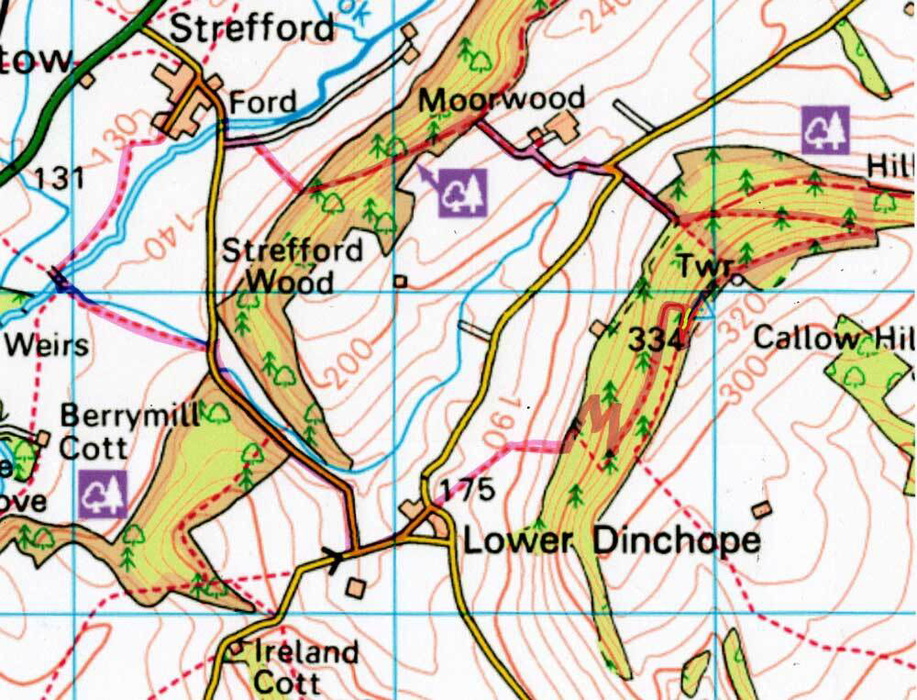
Walk 8 Callow Hill and Flounders Folly
Author’s Note October 2023: The eight years since the route was first written has seen the forestry tracks reduced to narrow paths by growing trees and thick vegetation. Many of the unused tracks are not now obvious on the ground making the previous description superfluous and the right of way shown on current maps as mentioned in the previous text, does correspond to the lines shown on the map.
P61 para 2
On entering Strefford Wood the gradients steepen. On reaching a hollow with a path crossing ignore a muddy path climbing through a deep cutting and instead follow a parallel one a few yards to the left (Note; Not the slimy wider track 20m to the left). This starts uncertainly but soon becomes clear as it takes you on an embankment overlooking the main path. As the cutting ends the routes join forces and the going gets easier, raking up to the top of Wenlock Edge. Leave the edge path for a pleasant hedge-lined farm track on the right. This eventually joins the tarred access lane from Moorwood Farm, which in turn leads to a country lane with a triangular grassy island. Turn right towards the afforested Callow Hill. At the first corner leave the lane to go straight ahead on a forestry road – there’s a Flounder’s Folly information sign here.
P62 Para 1
Not far up the track there’s a crossroads of tracks. Go straight ahead on the track that then rakes half left uphill. Ignore the left fork bridleway but stay with the main track, which is crowded by birch, beech, rowan, ash and sycamore. Near the top of the ridge it doubles back right – now raspberries, elders and bramble are added to the rampant vegetation so there’ll be plenty of nourishing berries in the summer. The stone tower of Flounder’s Folly appears suddenly as you go through the gate at its foot. There are superb views and lots of seating to enjoy them.
Continue on a narrow path through the trees then go left through a kissing gate to follow the edge. The right of way shown on the map as descending into Callowhill Plantation does not exist on the ground but there’s a waymarked path just beyond wooden duckboards and railings at SO 459 849 that replaces it. The path down through the forest is signed with light blue Flounders Folly signs and waymarker arrows that don’t correspond to the right of way marked on current maps. The narrow path angles back right then, at another waymarker post, descends steeply left in steps to reach a forestry track path, which will zig zag down to the bottom of the plantation. Many of the marked forest tracks are now overgrown and will not be noticed.
Turn left along the bottom path, which is currently narrow and overgrown.
December 2021
2021 reprint route updates
807 Reprint 2021 (3.953 MB)
July 2021
22 The Long Mynd Skyline
P125/6
The following paragraph should say left, and not right.
Stay with the valley path ignoring paths to both left and right. The path passes to the left of the most northerly visible earthwork section of Cross Dyke, a Bronze Age border. Beyond this the valley becomes shallow and the path narrows and fades into the grass. Leave the hollow on a path at SO 443967 that has come down the hillsides to the left. This angles back right to join and turn left along another path with the fields of High Park not far to the right. The path in turn joins a wide grass track running parallel to the field edge. Take the less prominent right fork track at SO 439 967, where the track gets closest to the fields.
July 2020
Corrections
Walk 5 Bury Ditches
Page 46, para 1
Should read eastern edge not western
Page 47, para 1
Should read western end not eastern
January 2020
2020 reprint route updates
807 Hillwalking in Shropshire 2020 (8.541 MB)
May 2018
Correction
On page 16, 164 and 166 the book states that Thomas Telford designed the Ironbridge. It should have read Thomas Farnolls Pritchard drew up the original designs for the Ironbridge under the instructions of Abraham Darby III. The bridge was finished after Pritchard’s death.
Free Royal Mail 48 postage on UK orders. European postage is £3.50 per item. Worldwide postage is £5.50 per item. If you're not happy with your purchase for any reason, we'll give you a full refund.
Learn moreDiscover the Cicerone App
The Cicerone App brings decades of expertise straight to your phone, making it easier than ever to plan and enjoy your adventures wherever you are. For use with In-App guides — not compatible with eBooks.


Popular related guides


